

TL;DR:
- Effective team building in Berlin requires clear goals, structured strategies, and ongoing follow-up.
- Cultural activities like city tours, street art, and food experiences foster real connections and shared meaning.
- Measuring ROI through engagement, retention, and collaboration metrics ensures lasting behavioral change.
Organizing team building in Berlin sounds straightforward until you actually try it. You book a venue, arrange an activity, and watch your colleagues smile politely before returning to their usual silos on Monday morning. The real challenge is not finding something fun. It is finding something that genuinely shifts how people work together. Berlin's multicultural, fast-moving corporate environment demands more than a quiz night or a rented meeting room. This guide gives you actionable strategies, research-backed frameworks, and culturally rich activity ideas to help your team build real bonds that last beyond the event itself.
Table of Contents
- Set clear goals and criteria for team success
- Innovative Berlin team building activities that foster cultural appreciation
- Frameworks and strategies for lasting team impact
- How to measure and scale team building ROI
- Why the best Berlin team building blends culture, data, and continuous growth
- Bring authentic team building to your Berlin organization
- Frequently asked questions
Key Takeaways
| Point | Details |
|---|---|
| Set clear goals | Define team purpose and leadership criteria before choosing activities. |
| Embrace Berlin culture | Select immersive activities that connect teams with the city's history and diversity. |
| Prioritize ongoing strategies | Sustained engagement beats one-off events for higher performance and ROI. |
| Measure and adapt | Track real KPIs and scale what works for hybrid or large Berlin teams. |
Set clear goals and criteria for team success
Before you browse activity catalogs or compare venues, start with a harder question: what do you actually want your team to change? This is the step most leaders skip, and it is precisely why so many team building events feel forgettable a week later.
The most impactful programs begin with organizational goals, not activity preferences. Ask yourself whether you want to improve cross-department communication, reduce onboarding friction, or rebuild trust after a difficult restructure. Each goal points to a different type of experience. Mixing up those objectives leads to mismatched activities and wasted budget.
Here is a simple approach to setting team building criteria:
- Define your team purpose. What is this group trying to accomplish together? A shared mission gives team building a reason to exist beyond entertainment. Defining team purpose leads to 5.6x higher engagement, according to Gallup-backed data from Deloitte.
- Set SMART goals for the event. Specific, Measurable, Achievable, Relevant, and Time-bound goals keep planning focused. Instead of "improve morale," aim for "increase cross-team collaboration on at least two projects within 60 days of the workshop."
- Get leadership buy-in early. Managers who visibly participate signal that this matters. Without that signal, employees often treat events as optional social time.
- Establish baseline engagement metrics. Use a short pre-event survey to capture how connected people feel, how often they collaborate across teams, and how much they trust leadership. This gives you something concrete to measure against later.
- Plan weekly check-ins after the event. Team building statistics consistently show that follow-up rituals are what separate one-off events from lasting behavioral change.
If you want to go deeper on structuring this process, the corporate team bonding guide for Berlin teams is a solid starting point. You will also find practical team bonding workflow tips that translate strategy into real scheduling decisions.
Pro Tip: Skip the post-event satisfaction survey as your only measure. Instead, track behavior changes over 30, 60, and 90 days. Did collaboration actually increase? Did communication improve? Behavior tells you far more than a happiness score.
Innovative Berlin team building activities that foster cultural appreciation
Berlin is one of Europe's most culturally layered cities. That is not a backdrop. It is an asset. The best team building activities here do not just happen in Berlin. They draw from it.
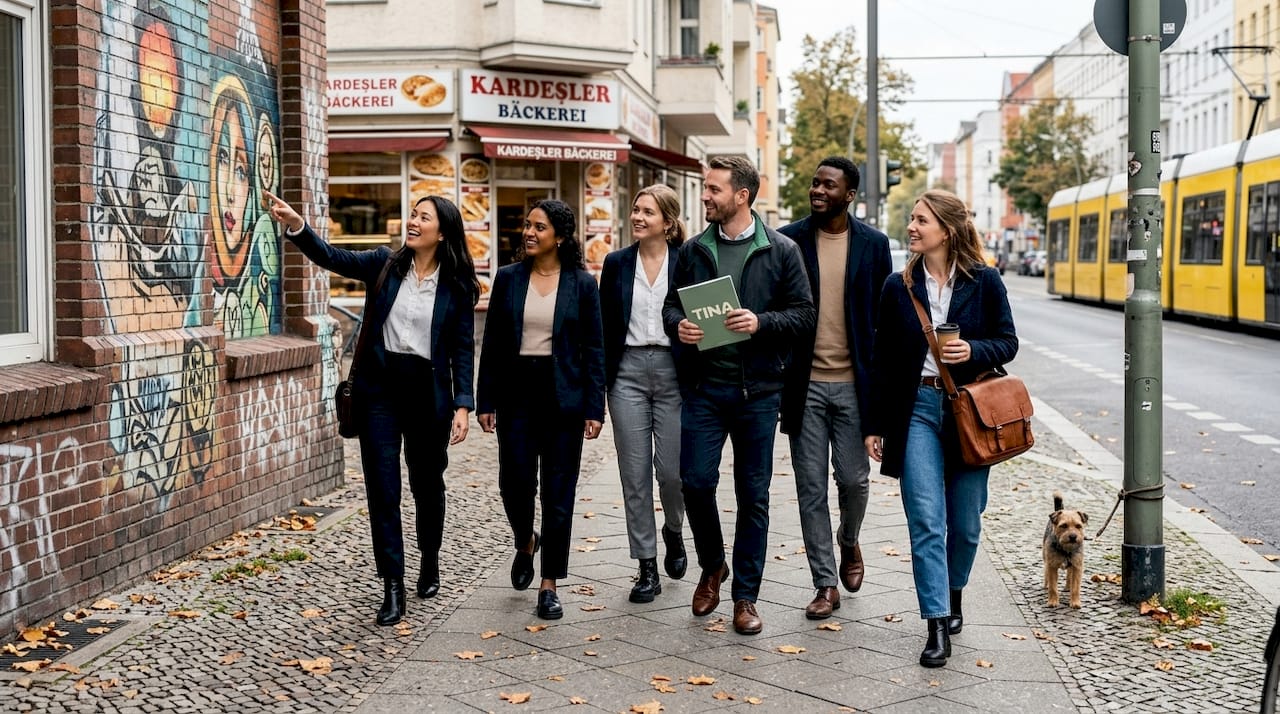
Cultural tours, street art walks, food experiences, and decolonial tours engage teams while they explore Berlin's history and diversity. These are not passive experiences. They require teams to navigate, discuss, make decisions, and often challenge their own assumptions. That is where real connection happens.
Here is a look at the top activity types and what makes each one work:
- 🗺️ City scavenger hunts: Teams solve clues across Berlin neighborhoods, mixing problem-solving with movement. Works well for groups of 10 to 200. Customizable around company values or neighborhood themes.
- 🎨 Street art and graffiti tours: Berlin's street art scene is a living history lesson. Guides connect murals to political and social movements, sparking conversations that rarely happen in conference rooms.
- 🍽️ Food tastings and culinary workshops: From traditional German cooking to global cuisines reflecting Berlin's immigrant communities, food creates immediate common ground. These also work beautifully as in-office experiences.
- ✊ Decolonial and Black Feminism tours: For teams serious about diversity, equity, and inclusion, these tours reframe Berlin's history through perspectives rarely covered in standard tours. Provocative, memorable, and deeply educational.
- 🖶 Artisan craft workshops: Hands-on experiences like pottery, chocolate making, or jewelry design level the playing field instantly. Nobody walks in as an expert. Suddenly, the intern and the team lead are struggling equally to center a clay bowl, and something real happens between them.
| Activity type | Group size | Duration | Hybrid-friendly |
|---|---|---|---|
| City scavenger hunt | 10 to 200 | 2 to 3 hours | Partial |
| Street art tour | 8 to 50 | 1.5 to 2 hours | No |
| Food tasting/workshop | 8 to 80 | 2 to 4 hours | Partial |
| Decolonial tour | 8 to 40 | 2 hours | No |
| Artisan craft workshop | 6 to 60 | 2 to 3 hours | Yes (in-office) |
For more inspiration, browse experiential team building ideas or explore unique Berlin experiences curated for corporate groups. You can also check out more Berlin team activities for a broader overview of what the city offers.
Pro Tip: If your team is distributed, combine an in-person cultural tour for Berlin-based colleagues with a virtual follow-up session where remote members can share reflections or join a digital workshop version. Inclusion matters even when people are not in the same room.
Frameworks and strategies for lasting team impact
Here is the uncomfortable truth about most team building programs: they work for about three days. Then the forgetting curve kicks in and things drift back to normal. This is not a problem with the activities. It is a problem with the strategy around them.
One-off events fail because they lack structure before and after the experience. Effective team building is an ongoing practice, not a calendar event.
These are the frameworks that actually sustain impact:
- Tuckman's Stages of Team Development. Forming, Storming, Norming, and Performing. Ongoing strategies over one-off events move teams through these phases faster and more intentionally. Knowing which stage your team is in helps you choose the right type of activity.
- SMART goal integration. Attach every team building initiative to a measurable workplace goal. This gives the experience organizational weight and a reason to follow up.
- Regular feedback loops. Quarterly check-ins, peer recognition rituals, and team retrospectives keep momentum alive between events.
- Leader-led development. Management accounts for roughly 70% of variance in team engagement. Leaders who model vulnerability, celebrate effort, and actively reinforce lessons from team building activities see dramatically better results.
- Emotional intelligence training. Embed EQ skills into team building by choosing activities that require listening, perspective-taking, and collaboration under mild stress.
The numbers are clear: High-performing teams are 5x more likely to succeed, and organizations that invest consistently in team development see ROI as high as 600%. These are not soft metrics. They show up in revenue, retention, and speed to market.
| Approach | Short-term impact | Long-term impact |
|---|---|---|
| One-off fun event | High energy, low retention | Minimal behavioral change |
| Structured program with goals | Moderate energy, clear direction | Sustained collaboration gains |
| Culture-first + leader-driven | Deep connection, shared language | Measurable performance improvement |
For teams ready to act on this, creative workshops for teams in Berlin offer a practical starting point. And if you want the business case in one place, the team building profit impact article lays out the connection clearly. The Deloitte team frameworks resource is also worth bookmarking for leadership development context.
How to measure and scale team building ROI
If you cannot measure it, you cannot improve it. This is where many HR managers and team leaders get stuck. They feel confident the experience was valuable but struggle to demonstrate that value to stakeholders.
The good news: measuring team building ROI is simpler than it sounds when you know what to track.
Here are the core measurement tools:
- 📊 Engagement surveys: Run them before the event, immediately after, and at 60-day intervals. Look for shifts in how connected people feel and how often they initiate collaboration.
- 📉 Retention rates: Teams that feel genuinely bonded stay longer. Track voluntary turnover in the 6 to 12 months following a structured program.
- 💬 Feedback frequency: Are people giving and receiving peer feedback more often? More honest feedback signals higher psychological safety.
- 🤝 Cross-team collaboration indicators: Count joint projects, shared Slack channels, or cross-department meetings before and after.
- ⏱️ Productivity proxies: Output quality, project completion speed, and error rates all reflect how well a team is functioning.
Teams see 20% higher engagement, 50% more productivity, and 21% greater profitability with robust team building investment. Those numbers do not happen by accident. They happen when programs are measured, iterated, and scaled intentionally.
| KPI | Measurement method | Target benchmark |
|---|---|---|
| Employee engagement score | Pre/post survey | 15 to 20% increase |
| Voluntary turnover | HR retention data | 10% reduction within 12 months |
| Cross-team projects | Project management tool | 25% increase within 6 months |
| Peer feedback frequency | 360 feedback tool | 30% increase within 90 days |
| Productivity output | Project completion rate | 20% improvement |
For scaling across larger or more diverse groups, the key is modularity. Break large programs into smaller cohort experiences that can be customized by department, function, or seniority level. Then bring groups together for shared capstone activities. Explore authentic team building activities that work across group sizes, or discover how team collaboration venues in Berlin can enhance the experience physically. For a broader strategic view, scalable team strategies offers a useful framework.
Why the best Berlin team building blends culture, data, and continuous growth
Here is a perspective most team building guides will not give you: fun is overrated as a primary goal.
When leaders chase fun, they book escape rooms, hire comedians, and organize trivia nights. Everyone laughs. Nobody changes. The team returns to the same dynamics on Tuesday.
What actually shifts behavior is meaning. People need to feel that what they experienced mattered. That it connected to something real about who they are, how they work, and what their team stands for. Berlin is uniquely positioned to offer that. Its history of division and reunion, its radical street art, its immigrant communities, its artisan culture, all of it creates the raw material for deeply meaningful shared experiences.
The leaders who get the best results combine Berlin's cultural depth with proven frameworks and consistent measurement. They do not treat team building as a reward or a morale patch. They treat it as a leadership tool. The contrast is stark: teams that do cultural immersion activities tied to clear goals and followed by structured reflection show measurable performance gains. Teams that just "do something fun" show temporary mood improvement.
If you are serious about change, invest in depth over frequency. One experiential Berlin workshop with real cultural meaning and a clear follow-up plan will outperform three generic events every time.
Bring authentic team building to your Berlin organization
You now have the strategy. The next step is finding experiences worth building around.
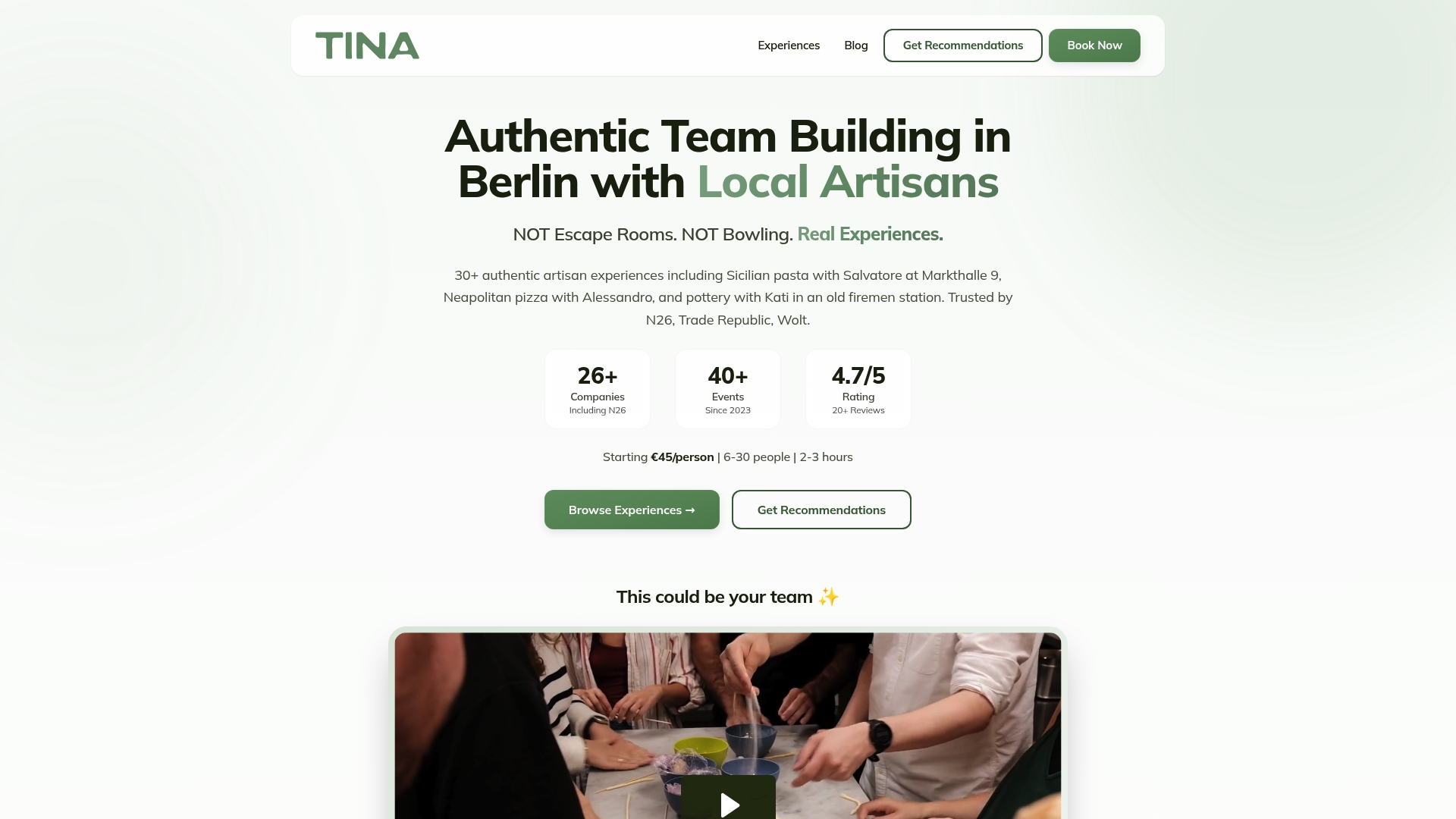
TINA connects Berlin teams with real local artisans for hands-on workshops that break down social barriers and create genuine bonds. Whether your group wants to try a custom company merchandise workshop or craft their own piece of jewelry at a jewelry ring workshop, TINA offers experiences designed for all group sizes, from intimate teams to large departments. In-office and atelier options mean flexibility is built in. Browse the full catalog, check transparent pricing, and book directly. No gatekeepers, no generic packages, just authentic Berlin creativity for your team.
Frequently asked questions
What are the most effective team building activities for diverse teams in Berlin?
City scavenger hunts, street art and decolonial tours, and local food tastings work best because of their cultural depth and adaptability. Berlin's top team building naturally reflects the city's rich, multicultural identity.
How can we measure the ROI of team building programs?
Track engagement scores, retention rates, productivity indicators, and pre and post-event surveys for clear ROI benchmarks. Engagement and productivity KPIs are the most reliable indicators of whether your investment is working.
How can hybrid or remote Berlin teams do team building?
Blend in-person activities for local colleagues with virtual workshops or asynchronous creative challenges for remote members. Hybrid teams need adaptable formats that make participation equally meaningful regardless of location.
What size of group can participate in these activities?
Berlin team building experiences scale from groups as small as 5 to over 500, with both onsite and hybrid options available. Activities work for groups 5 to 500+, making them suitable for startups and enterprise teams alike.