
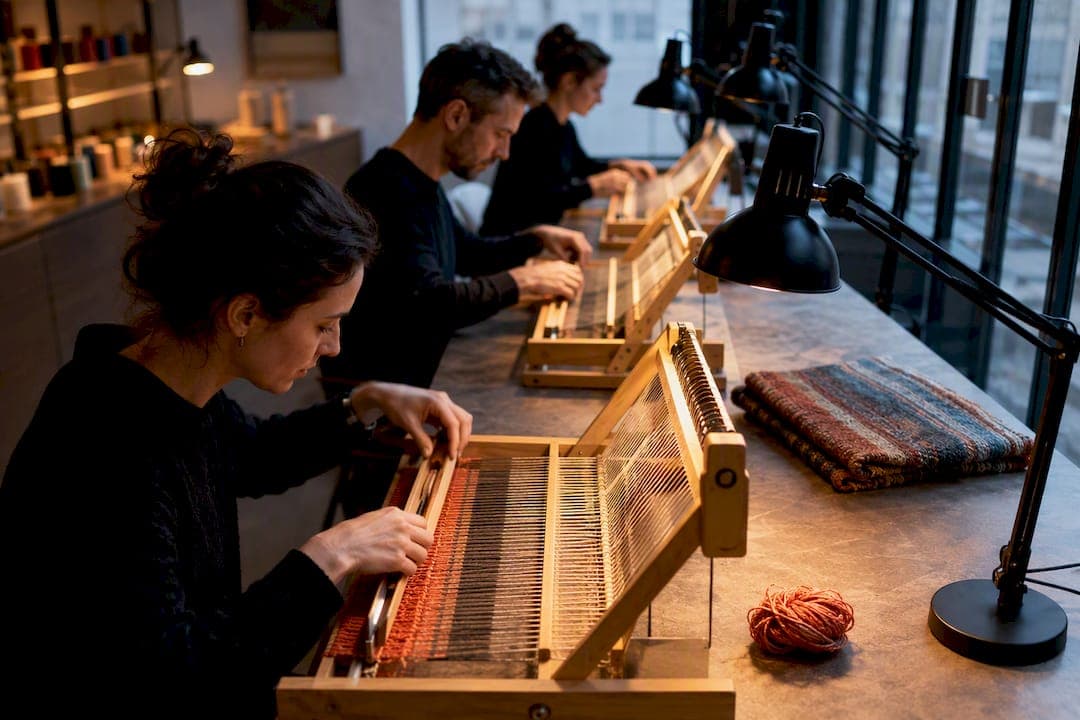
Weaving workshops are a practical, low-pressure team building activity, and corporate groups in Berlin can book one through a team building platform. If your team needs something hands on that beats another escape room, request a group quote now and check available dates before your next planning cycle closes.
TL;DR:
- Most weaving workshops in Berlin accommodate groups of eight to twenty, with instructor-to-participant ratios ensuring personalized guidance for each person.
- Sessions typically last between 1.5 to three hours, producing individual woven pieces such as small wall hangings or swatches, with multi-day options for extended projects.
- Cost per participant generally starts around €40 for introductory sessions, but custom rates apply for smaller groups of one to three people.
- Studios can scale up for larger teams through additional facilitators or multiple looms, though beyond twenty participants, logistical challenges may arise.
- Key considerations before booking include checking loom capacity, material sensitivities, accessibility, and ensuring clear communication about scope, schedule, and personalization options.
Table of Contents
- What Does a Weberei Workshop in Berlin Involve for Teams?
- Group Sizes, Session Lengths, and Sample Pricing in Berlin
- Why Weaving Works for Team Building
- Booking Checklist: What to Ask Before You Confirm
- Where Berlin Workshops Run and What to Expect Onsite
- The History Behind Berlin's Weaving Tradition
- Who Actually Teaches These Sessions?
- Customizing a Session for Your Specific Team
- What Past Team Sessions Have Looked Like
- Handling Safety and Accessibility Around Looms
- Tina's Perspective: Why Curated Artisan Workshops Beat Generic Corporate Entertainment
- Ready to Book a Weaving Session for Your Team?
- Sources
- FAQ
What Does a Weberei Workshop in Berlin Involve for Teams?
A weberei workshop, the German term for a hand weaving session, puts your whole team in front of a frame loom with no prior experience required. That is the point. Nobody on your team has touched a gatterkamm (the weaving comb used to pack down each row) before, so the person who runs your budget forecasts and the newest hire on the team start from exactly the same spot.
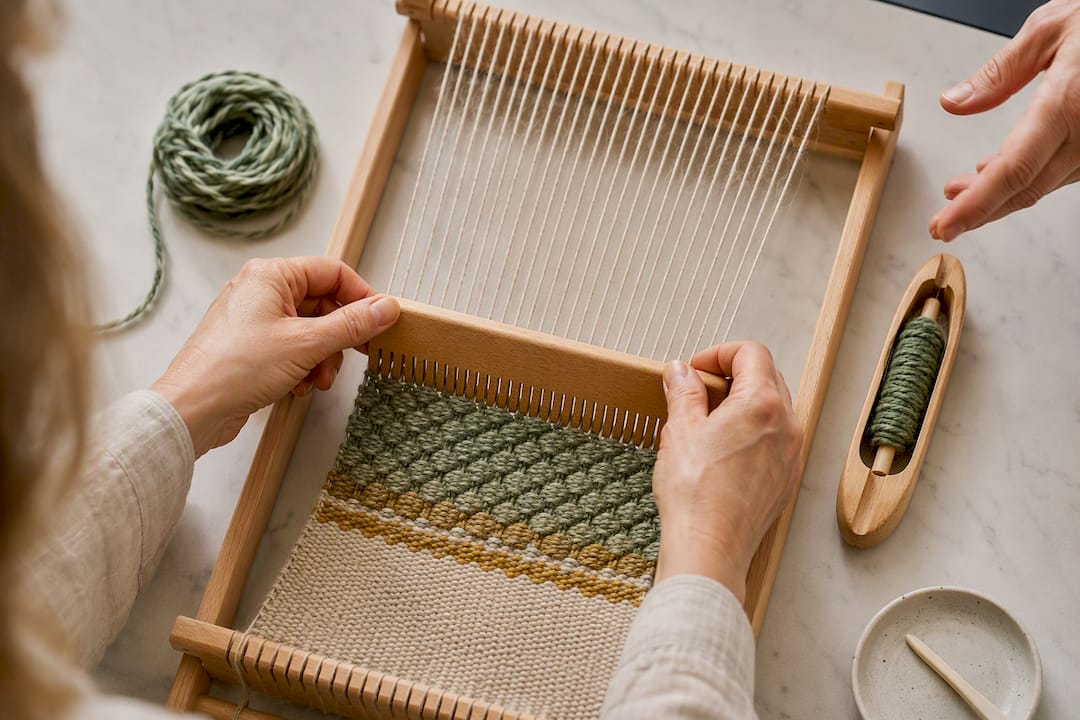
Berlin studios typically teach three approachable techniques for groups: plain weave for beginners, simple kelim patterns for those who finish early, and small tapestry details for anyone who wants to add texture. Textilwerkstatt Städler runs its weekly classes this way, moving participants from basic structure into pattern work within a single sitting.
Studios generally supply the core materials, and teams can add a personal touch on top:
- Wool, cotton, and linen yarn in a range of colors, plus effect yarns for texture
- Frame looms sized for beginners, already strung and ready to work
- Optional company colored yarn or small branded elements your team can bring
- Finishing tools like a gatterkamm, shuttle, and scissors
What you take home depends on the format. A three hour session usually produces one finished piece per person, often a small wall hanging or a woven sample swatch, as seen in workshops run by Berlin Textile Coop. Instructors typically split the time into a short demo, a longer hands on stretch, a finishing period, and a few minutes where the group looks at what everyone made together.
Group Sizes, Session Lengths, and Sample Pricing in Berlin
Most Berlin weaving studios keep instructor ratios tight on purpose. Textilwerkstatt Städler runs its weekly classes in groups of three to five, which means everyone gets real hands on correction instead of a rushed demo they half remember.
Studios like Textilwerkstatt Städler keep instructor ratios tight to ensure substantial individual loom time during sessions. For a team of twelve, that usually means multiple looms running at once, or a studio bringing in a second facilitator.
Session formats vary by what your team wants to walk away with:
- A 1.5 hour introductory session, close to what weekly classes at Städler run
- A half day format of about three hours, matching the Berlin Textile Coop beginner frame loom workshop
- Multi session projects spanning one to five days, similar to the intensives offered at Studio Jumi
Pricing runs on a per person basis for larger groups, with real flexibility for smaller ones. Local listings show introductory sessions priced around €40 per participant with a minimum group size, while groups of one to three people are often quoted custom rates instead of a fixed per head price. Ask your studio directly about deposits, since most Berlin ateliers require one to hold a date, along with a stated minimum headcount and a cancellation window, usually somewhere between one and two weeks before the session.
Why Weaving Works for Team Building
Manual craft strips away office rank fast. Put a department head at a loom next to someone three months into the job, and the department head is not automatically better at it. Weaving in particular rewards patience over seniority, which flips the usual meeting room dynamic on its head.
Teams that have gone through a session tend to report the same shifts: more sidebar conversation than a normal offsite produces, people asking each other for help with tension or pattern instead of defaulting to whoever is senior, and a real sense of ownership once a finished piece comes off the loom. Studio Jumi frames its sessions around exactly this mix of hands on technique and open ended creative problem solving, which is part of why art led studios work well for teams that want more than a craft class.
Weaving tends to land best with groups of eight to twenty, held in a proper studio or a roomy office space with good natural light. Anything larger starts to strain loom availability unless the studio scales up facilitators to match.
Pro Tip: Ask your team lead to sit at a different loom than their usual seat at the conference table. The physical reset does more for breaking hierarchy than any icebreaker script.
Some team building platforms work with artisan partners across pottery, tufting, and textile crafts precisely because this dynamic repeats itself. If you want to see how a similar hands on craft plays out with a corporate group, the group tufting workshop in Berlin follows the same equal footing principle with a different material.
Booking Checklist: What to Ask Before You Confirm
Before you sign off on a weaving session, run through this list with the studio or artisan:
- Confirm group capacity against loom count. Ask directly whether looms and instructors scale up for larger teams, or whether you are capped at whatever the studio normally runs.
- Check materials and allergens. Wool and certain dyes can trigger sensitivities, so ask what fibers are in use and whether cotton or synthetic alternatives exist for anyone who needs them.
- Confirm the language of instruction. Many Berlin studios teach in German by default, so request English instruction in writing if your team needs it.
- Ask about accessibility and transit. Get the exact address, confirm step free access if needed, and check the nearest U-Bahn or S-Bahn stop for anyone traveling from another office.
- Nail down invoicing. German companies need a proper VAT invoice, not just a receipt, so confirm this before the deposit goes out along with the exact deposit amount and cancellation window.
- Request a sample schedule and example finished pieces. A studio that can show you photos from a past session sets real expectations for what your team will walk away with.
Pro Tip: If a studio hesitates on question one, that is your answer. A vendor that cannot say clearly how they scale for twelve or twenty people will improvise on the day, and improvising with looms costs you time you do not have.
Where Berlin Workshops Run and What to Expect Onsite
Active weaving studios cluster in a handful of Berlin neighborhoods, and each one has a slightly different feel. Prenzlauer Berg, home to Textilwerkstatt Städler, leans calm and residential, good for a low key morning session. Charlottenburg and Friedrichshain, where Studio Jumi and Berlin Textile Coop operate, run more toward converted loft spaces with an artistic edge.
Ask about these before booking:
- Whether catering or coffee service is available, or if you need to bring your own
- Restroom access, seating for anyone not weaving, and coat or bag storage
- Step free entry and the general accessibility of the workspace
Many smaller ateliers occupy older buildings without elevators, so request photos or a quick site visit if accessibility is a concern for your group.
The History Behind Berlin's Weaving Tradition
Weaving in the Berlin region traces back through centuries of German textile craft, long before the city became a hub for Bauhaus era design experimentation. The Bauhaus movement, founded in Weimar in 1919 and later based partly in Berlin, treated weaving as a serious design discipline rather than a domestic skill, with its textile workshop producing some of the most influential woven work of the twentieth century.
That history matters for a modern corporate session because it shapes how today's studios frame the craft. Some Berlin ateliers lean into the technical, almost engineering minded approach that traces back to Bauhaus pattern theory. Others treat weaving more as folk craft, closer to the rural hand weaving traditions that predate the movement entirely.
For a team booking a session now, the practical result is variety. A studio with a Bauhaus leaning teaching style will likely push your group toward structure and precision, counting threads and following a strict pattern. A studio rooted in folk tradition will probably give your team more room to improvise once the basic technique clicks. Neither approach is wrong, but it changes what kind of session you are signing up for, so it is worth asking a studio which tradition shapes their teaching before you book. The answer tells you whether your team will spend the afternoon following instructions closely or making things up as they go, which matters if your goal is loosening people up rather than testing their focus.
Who Actually Teaches These Sessions?
Instructors running Berlin weaving workshops generally come from one of two backgrounds. Some trained formally in textile design or fine art and now run their own studio practice, teaching workshops alongside gallery or commission work. Others come up through traditional craft apprenticeships and have spent years at the loom before ever teaching a group.
Studio Jumi's instructors, for instance, frame sessions around contemporary textile art, pairing hands on technique with genuine artistic context, which suits a team that wants the session to feel less like a factory tour and more like a creative afternoon. A studio built around a single artisan's decades of craft experience, on the other hand, tends to move faster into pure technique because that instructor has taught the same fundamentals hundreds of times.
Ask a studio directly how long their lead instructor has been teaching groups specifically, not just weaving personally. Someone who has spent fifteen years perfecting their own tapestry work is not automatically good at explaining tension control to twelve strangers who have never held a shuttle. The teaching skill and the craft skill are related but separate, and a studio that has run corporate sessions before usually has an instructor who has already made the mistakes worth avoiding on your team's dime.
Customizing a Session for Your Specific Team
Standard weaving sessions work fine for most groups, but several studios will adjust the format for specific goals. If your team wants a tangible piece of company culture to hang in the office afterward, ask about incorporating company colors into the yarn selection, or weaving a shared piece that combines everyone's individual sections into one larger hanging.
Teams focused on sustainability messaging sometimes request natural or deadstock fiber sourcing instead of standard synthetic blended yarns, which several Berlin studios can accommodate with advance notice. Groups celebrating a milestone, a product launch or a work anniversary, sometimes ask the instructor to build a short reflection period into the closing minutes. This gives people a moment to talk about what the finished piece means before everyone heads back to the office.
Larger teams split across departments can also request a modified format where small groups each weave one section of a larger collaborative piece, which turns the finished result into something closer to a genuine group project than twelve separate souvenirs. This works particularly well for teams that want the activity to double as a visible symbol of collaboration rather than just an afternoon off from meetings.
Whatever the customization, confirm it in writing before the session, including any changes to pricing, since custom material sourcing or a modified collaborative format often shifts the quote from standard per person rates.
What Past Team Sessions Have Looked Like
A weaving session works best when the format matches the size and mood of the group booking it. A small marketing team of eight, for example, fits comfortably into a single studio room with one instructor managing the whole group, finishing individual sample swatches within a standard three hour window similar to the Berlin Textile Coop format.
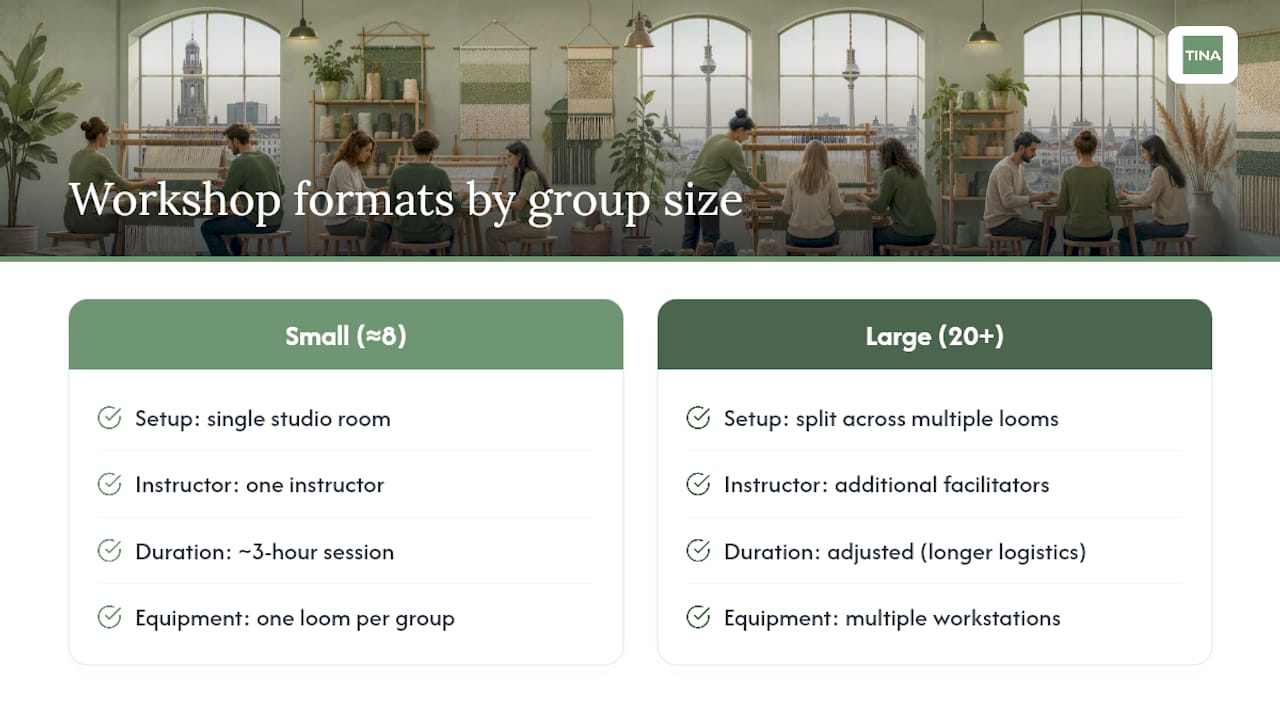
A larger cross departmental group of twenty or more usually needs a different setup entirely, often split across multiple looms with additional facilitators brought in to keep hands on time high rather than leaving half the group standing around waiting for a turn. That kind of scaling question is one reason a team building platform might coordinate directly with artisans on staffing before confirming a larger booking, rather than assuming a studio built for weekly classes of five can absorb a group four times that size without adjustment.
Outcomes tend to track group size closely. Smaller teams report more one on one instructor time and finish more technically complete pieces. Larger teams report more of the informal cross department conversation that HR teams are usually chasing when they book this kind of event in the first place, even if the finished pieces themselves are simpler. Neither outcome is better, but knowing which one your team actually needs before booking saves a round of disappointed feedback afterward.
Handling Safety and Accessibility Around Looms
Weaving equipment carries fewer safety concerns than most craft activities, but a few points deserve attention before your team shows up. Wool and certain dye treatments can trigger allergic reactions in a small number of participants, so confirm with the studio whether cotton or synthetic alternatives are available for anyone with a known sensitivity, and mention it during booking rather than on the day.
Looms themselves are largely low risk. The main physical concern is repetitive hand motion over a long session, which is rarely an issue for a single afternoon but worth flagging if anyone on your team has an existing wrist or hand condition. Shuttles and combs have no sharp exposed edges in a properly maintained studio, though it is fair to ask how frequently a studio inspects and restrings its looms.
Accessibility runs deeper than the loom itself. Many Berlin ateliers occupy older buildings, and step free entry is not guaranteed. If anyone on your team uses a wheelchair or has limited mobility, request photos of the entrance and workspace, or ask for a short video walkthrough, before locking in a venue. A studio that cannot easily answer this question is one where you should request a site visit ahead of the actual booking date.
Tina's Perspective: Why Curated Artisan Workshops Beat Generic Corporate Entertainment
What sold me on weaving as a corporate format is how little it asks anyone to pretend. Nobody fakes competence at a loom, and that honesty is rare in a workplace built on performing confidence. Team building platforms vet artisans carefully, checking whether a session actually humbles a group or just entertains it. The two are not the same thing, and only one of them changes how a team talks to each other on Monday.
— Tina
Ready to Book a Weaving Session for Your Team?
Such platforms often handle the part most HR teams dread: chasing down artisans, comparing quotes, and managing invoices. They match your team with vetted Berlin weavers, provide transparent pricing upfront, and facilitate proper corporate invoicing.
Getting started takes one message. Tell us your headcount, preferred neighborhood, and rough date, and we typically come back with a workshop option and a quote within a couple of business days. Beyond weaving, our creative workshops in Berlin span pottery, tufting, and other artisan formats if your team wants to compare options before deciding. Some groups also look at flexible private venue space through partners like Woolink when a studio alone will not fit a larger offsite.
If you already know weaving is the right call, request your team building quote directly and we will confirm a date, an artisan, and a price before your next planning meeting.
Sources
- Webkurs Berlin – Weben lernen & Weaving Courses | Textilwerkstatt Städler
- STUDIO JUMI - Weaving Studio Berlin
- Webkurse und Wollworkshop | handgewebt in berlin
- weaving — berlin textile coop.
FAQ
How much does a weaving workshop cost per person in Berlin?
Introductory sessions run around €40 per participant with a minimum group size, though groups of one to three people are usually quoted custom rates instead of a fixed price.
How long does a team weaving session usually last?
Most sessions run either a 1.5 hour introductory format or a half day format of about three hours, with multi day intensives available for teams wanting a deeper project.
What is the ideal group size for a weaving workshop?
Weaving tends to work best for groups of eight to twenty, since smaller studios typically run classes in groups of three to five and need extra looms or facilitators for anything larger.
Do participants need any prior weaving experience?
No prior experience is expected or needed. Studios teach beginner techniques like plain weave from the first few minutes, which is part of why the format levels the playing field across job titles.
Can Tinaexperiences book a weaving workshop for a corporate team in Berlin?
Yes. Tinaexperiences coordinates directly with vetted Berlin artisans to match group size, handle transparent pricing, and manage corporate invoicing for team weaving sessions.