

The most effective sustainable corporate event ideas are: go paperless with QR programs; choose venues certified under ISO 20121, EMAS, EU Ecolabel, or Green Key; serve plant-forward local catering; promote rail and public transport; offer hybrid or virtual attendance; use rental and circular decor; run rigorous waste separation and composting; measure carbon per attendee before offsetting; skip single-use giveaways entirely; and book artisan-led hands-on workshops that need no temporary staging. For Central Europe planners who want a ready-made, low-waste option right now, Tinaexperiences connects Berlin teams with local artisans for pottery, pasta-making, foraging, and more — real venues, real craft, near-zero build requirements.
- Paperless communications: Switch invitations, programs, and signage to QR codes and digital platforms. First step: pick one digital event tool (Eventbrite, Sched, or a custom landing page) within 48 hours of briefing.
- Certified venues: Ask for ISO 20121, EMAS, EU Ecolabel, or Green Key documentation before signing. First step: add a certification requirement to your RFP template today.
- Plant-forward local catering: Prioritize seasonal, regional, vegetarian and vegan dishes. First step: request a plant-forward menu draft from your caterer within 72 hours.
- Low-carbon travel: Provide rail and public transport directions prominently; arrange a shared shuttle for groups. First step: add a "how to arrive by train" block to your save-the-date.
- Hybrid and virtual formats: Offer a streaming option to cut long-haul travel. First step: confirm your AV setup supports a live stream before finalizing the venue.
- Circular decor and rental furniture: Rent, borrow, or reuse all staging. First step: ask your decor supplier for a rental-only quote.
- Waste separation and composting: Set up labeled stations for organic, recyclable, and residual waste. First step: brief your venue on waste station placement at the walkthrough.
- Carbon accounting before offsetting: Measure kg CO2e per attendee first; offset only what you cannot reduce. First step: use the atmosfair event calculator to baseline your next event.
- Sustainable swag or no-swag: Default to no giveaways; if gifts are needed, require local production and lifecycle proof. First step: remove giveaways from the budget draft unless a clear case exists.
- Artisan-led workshops: Hands-on craft sessions use existing venues and materials, eliminating temporary builds. First step: browse TINA's artisan workshop options and request availability.
Pro Tip: Add a single line to every supplier brief: "Please provide your sustainability certification number or documented KPIs for energy, waste, and sourcing." It takes 30 seconds and immediately filters out vendors who cannot deliver.
Key Takeaways
Sustainable corporate events reduce emissions and often lower net costs when planning decisions on venue, catering, transport, and materials are made early and measured consistently.
| Point | Details |
|---|---|
| Plan early, lock in KPIs | Add sustainability metrics to the brief before the first RFP goes out — decisions made in planning determine most of the event's footprint. |
| Venue certification matters | Require ISO 20121, EMAS, EU Ecolabel, or Green Key documentation; buildings account for around 35% of final energy consumption in Germany. |
| Default to no giveaways | Single-use gifts create waste and low reuse value; skip them by default and invest the budget in the experience instead. |
| Measure before you offset | Calculate kg CO2e per attendee first using a standardized tool; offset only what you cannot reduce through venue, travel, and catering choices. |
| Tinaexperiences for Berlin teams | Artisan-led workshops at real venues eliminate temporary staging, support local artisans, and deliver memorable low-waste team events across Central Europe. |
Table of Contents
- Why sustainable events make business sense
- 10 sustainable corporate event ideas, step by step
- How to vet venues, caterers, and suppliers
- Costs, timelines, and KPIs for common measures
- Pre-event, day-of, and post-event checklists
- A sustainable artisan workshop in Berlin: what it looks like in practice
- What running sustainable artisan events actually teaches you
- Tinaexperiences: artisan workshops built for low-waste team events
- Sources
Why sustainable events make business sense
Sustainable events reduce emissions and often lower net event costs when waste and procurement are optimized. That is not a feel-good claim. Planning decisions made early determine the majority of an event's environmental impact, and the same decisions that cut emissions tend to cut unnecessary spend: fewer printed materials, less single-use decor, smaller waste disposal bills, and shorter supply chains.
The environmental stakes are real. Buildings account for around 35% of final energy consumption and about 30% of CO2 emissions in Germany, making venue selection one of the highest-leverage choices a planner makes. Attendee travel adds another major slice, which is why rail preference and hybrid formats belong in every green event brief.
The business case is equally concrete:
- Employer brand: Employees and clients increasingly expect companies to walk their sustainability commitments. A well-documented green event is visible proof.
- Cost efficiency: Reduced waste volumes, optimized procurement, and longer-life equipment lower per-event spend over time, as UBA guidance confirms.
- Attendee experience: Plant-forward, locally sourced menus and authentic venue choices consistently score higher on post-event surveys than generic catering in generic spaces.
- Regulatory readiness: EU sustainability reporting requirements are tightening. Events that already track emissions and procurement data are ahead of the curve.
10 sustainable corporate event ideas, step by step
1. Choose a certified low-impact venue
Ask every venue shortlist candidate for their ISO 20121, EMAS, EU Ecolabel, or Green Key certificate before you visit. Certified venues have documented energy sources, waste handling procedures, and often existing public transport links.
Quick actions: add certification to your RFP; ask for the venue's annual energy report; confirm renewable electricity supply. KPI: venue certification status (yes/no) and energy source (renewable percentage).
2. Go fully paperless
QR codes on table cards replace printed programs. Digital signage replaces foam-board banners. A simple event app or landing page handles schedules, speaker bios, and post-event surveys.
Quick actions: select a digital event platform within 48 hours; brief your designer to produce digital-only assets; send a QR-code test to all team leads before the event. KPI: paper eliminated as much as possible (target minimal paper use).
3. Serve plant-forward, locally sourced catering
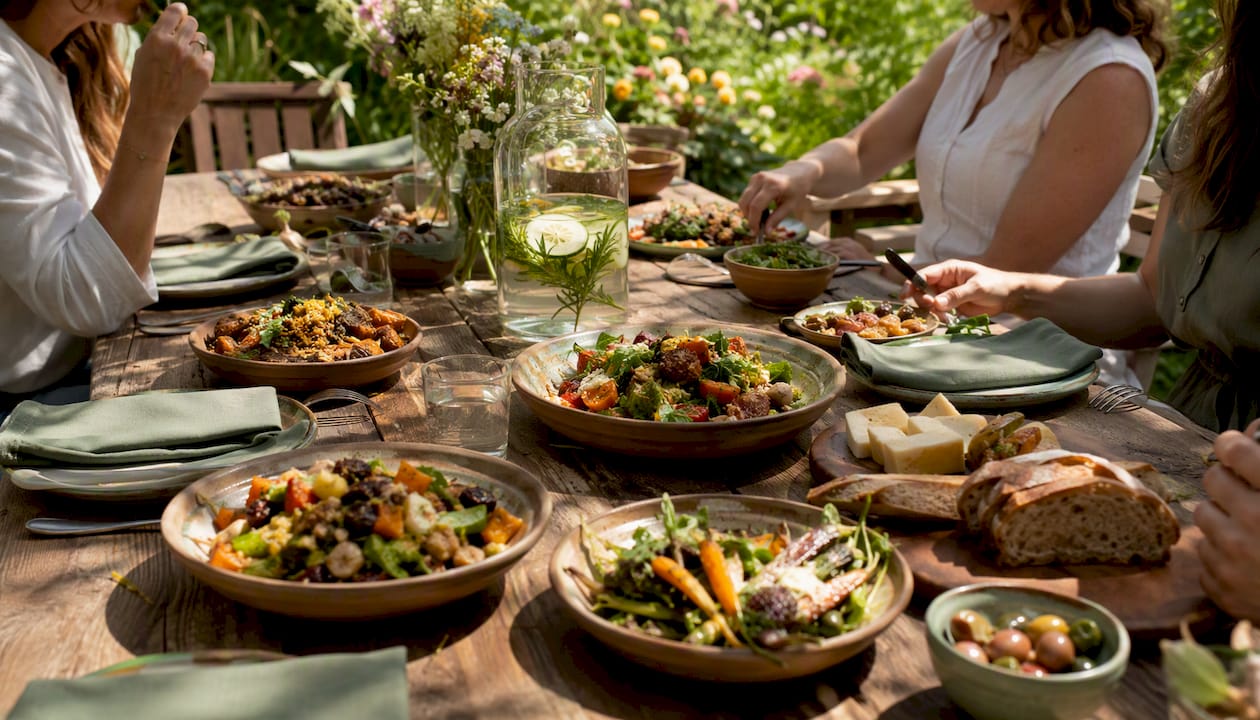
Local sourcing shortens supply chains, supports regional producers, and lowers transport emissions while improving the guest experience. A menu built around seasonal vegetables, legumes, and regional dairy cuts food-related emissions significantly compared to a meat-heavy buffet.
Quick actions: request a seasonal plant-forward menu draft; ask your caterer for the origin of the top five ingredients; set a realistic portion size to reduce surplus. KPI: proportion of plant-based dishes on the menu set as a target; food waste in kg per attendee. For a ready example of this in practice, Tinaexperiences runs a team day at an urban farm in Berlin where the menu goes from garden to table.
Pro Tip: Ask your caterer to partner with a local food rescue organization for surplus collection. It costs nothing extra and turns leftover food into a measurable social impact figure you can report.
4. Promote rail, public transport, and bike access
Practical guidance recommends preferring rail for regional journeys, providing clear public transport directions, scheduling events to allow train connections, and offering e-bike or bike parking. For groups traveling from outside the city, a shared electric shuttle from the main station cuts per-person emissions versus individual taxis.
Quick actions: add a "travel by train" section to your invitation; map the nearest U-Bahn or S-Bahn stop; arrange bike parking at the venue. KPI: percentage of attendees arriving by low-carbon transport (self-reported on registration form).
5. Offer hybrid or virtual attendance
Not every attendee needs to be in the room. A live stream option for remote colleagues cuts long-haul flights entirely for those participants. It also extends your event's reach without proportionally increasing its footprint.
Quick actions: confirm AV setup supports streaming before signing the venue contract; designate a remote-attendee coordinator; test the stream with a dry run 48 hours before the event. KPI: percentage of attendees joining remotely; estimated kg CO2e avoided by remote participation.
6. Use rental and circular decor
Single-use decor is one of the easiest waste sources to eliminate. Federal guidance recommends rental and reused temporary builds and avoiding disposable staging wherever possible. Rental furniture, reusable fabric banners, and potted plants that return to a nursery after the event all qualify.
Quick actions: request a rental-only quote from your decor supplier; specify no single-use items in the brief; arrange a post-event collection plan for all rented items.
7. Set up waste separation and composting
Labeled stations for organic waste, recyclables, and residual waste are the minimum. Brief your venue and catering team on the system before the event day. Assign one crew member per station during peak catering periods.

Quick actions: confirm the venue's waste handling capacity; order or rent labeled bins; brief all crew on sorting rules. KPI: kg waste diverted from landfill per attendee.
8. Measure carbon before you offset
Offsetting without measuring first is guesswork. Use a standardized tool to calculate kg CO2e per attendee across venue energy, catering, transport, and materials. Reduce what you can, then offset the remainder through high-quality projects. Measure travel emissions first and compensate only after reduction.
Quick actions: run your event through the atmosfair event calculator; document the result in your event brief; set a reduction target for the next edition. KPI: kg CO2e per attendee (track across events to show year-on-year improvement).
9. Skip the swag, or make it count
Avoiding giveaways is often the best default because single-use gifts create waste and low reuse value. Where a gift genuinely fits the event, require local production, a lifecycle statement, and real social value. A jar of honey from a Berlin rooftop apiary beats a branded tote bag made overseas.
Quick actions: remove giveaways from the budget by default; if gifts are retained, brief the supplier on local production and lifecycle requirements. KPI: giveaway items per attendee (target zero or one locally produced item).
10. Book artisan-led hands-on workshops
Craft workshops at existing artisan venues need no temporary staging, no branded foam structures, and no disposable props. The materials are the craft itself: clay, dough, yarn, foraged ingredients. Teams leave with something they made, not something that goes in the bin. Artisan workshops naturally reduce the need for heavy temporary builds and create memorable, low-waste experiences.
Pro Tip: Integrate sustainability KPIs directly into your event brief template, not as an afterthought. A brief that lists "kg CO2e per attendee" alongside "budget per head" signals to every supplier that sustainability is a selection criterion, not a nice-to-have.
How to vet venues, caterers, and suppliers
Ask for measurable evidence, not green claims. Any supplier can say they care about sustainability. The ones who actually do can show you a certificate number, a waste report, or a sourcing list.
Public sector guidance recommends integrating sustainability early and requiring certified venues as a baseline. Use these questions in every RFP and supplier call:
Venue questions:
- What is your energy source? Do you use renewable electricity?
- What is your waste handling setup? Do you compost organic waste?
- What public transport connections are within 10 minutes of the venue?
- Do you hold ISO 20121, EMAS, EU Ecolabel, or Green Key certification? Please provide the certificate number.
- What is your policy on single-use plastics and disposable materials?
Caterer questions:
- Where do your top five ingredients come from? Can you provide regional sourcing documentation?
- What percentage of your menu can be plant-based or vegetarian?
- How do you handle food surplus? Do you partner with a food rescue organization?
- Can you provide a sustainable food services statement or procurement policy?
Certifications to look for:
- ISO 20121: International standard for sustainable event management; covers planning, procurement, and operations.
- EMAS: EU Eco-Management and Audit Scheme; requires verified environmental performance data and public reporting.
- EU Ecolabel: EU-wide certification for products and services meeting strict environmental criteria; relevant for venues and catering suppliers.
- Green Key: International eco-label for tourism and hospitality venues; covers energy, water, waste, and staff training.
Red flags: vague language like "we care about the environment" with no data; inability to name their energy supplier; no local sourcing information; a default giveaway package with no lifecycle information; single-use everything in their standard setup.
Pro Tip: Add a reuse and return clause to every supplier contract: "All rented or borrowed items must be collected within 48 hours of the event." It prevents decor from ending up in a skip by default.
Costs, timelines, and KPIs for common measures
Many sustainable measures shift cost shape rather than inflating total spend. Eliminating printed materials saves money. Rental decor often costs less than purchased single-use staging. Plant-forward menus can be priced comparably to meat-heavy ones when sourced regionally. Sustainability-focused planning reduces long-term costs by eliminating unnecessary procurement and optimizing resource use.
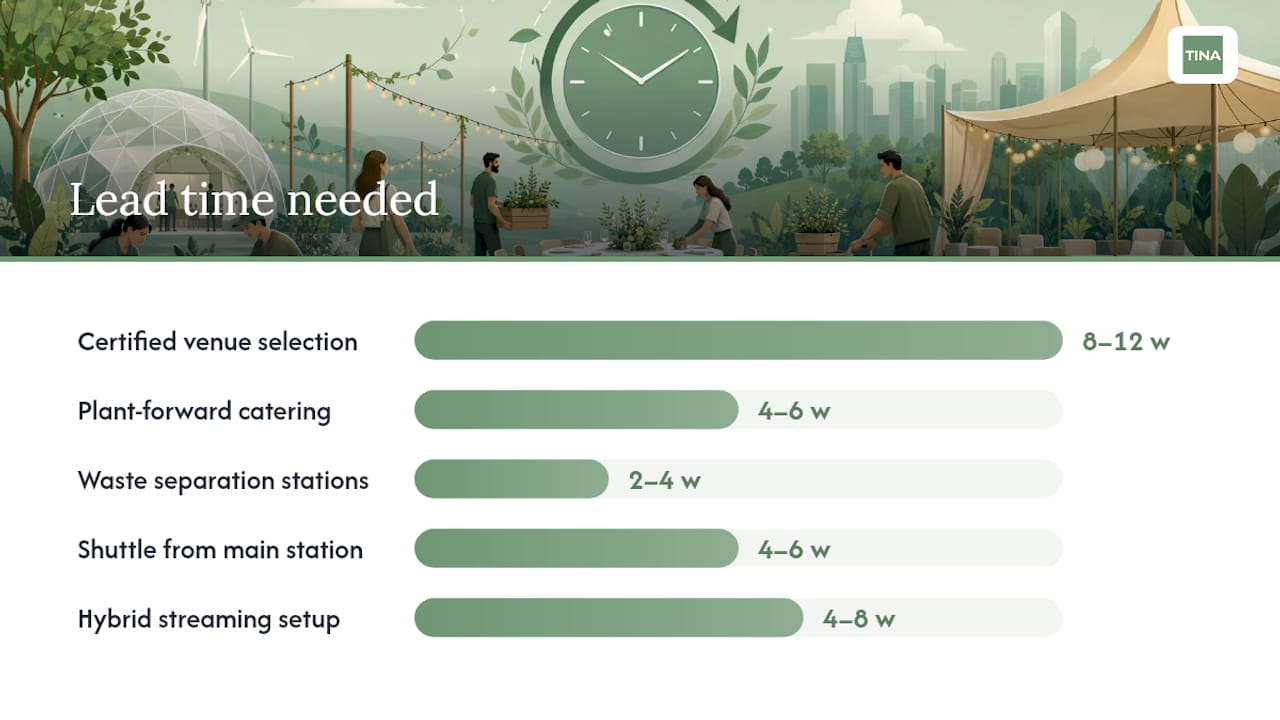
| Measure | Indicative cost impact | Lead time needed | Primary KPI |
|---|---|---|---|
| Certified venue selection | Neutral to +5% on venue fee | 8–12 weeks | Venue certification status |
| Plant-forward catering | Neutral to -10% vs. meat-heavy menu | 4–6 weeks | % plant-based dishes |
| No-giveaway policy | reduce swag budget entirely | a few weeks | Giveaway items per attendee |
| Waste separation stations | low-cost bin rental and signage | 2–4 weeks | kg waste diverted per attendee |
| Shuttle from main station | moderate cost per shuttle run | 4–6 weeks | % attendees on low-carbon transport |
| Hybrid streaming setup | variable cost depending on AV complexity | 4–8 weeks | % remote attendees; kg CO2e avoided |
A short-haul flight produces significantly higher CO2 emissions per passenger-kilometer compared to rail travel, making rail the preferred option to reduce emissions. Switching that group to rail for a Berlin event is one of the highest-impact single decisions a planner can make.
Recommended KPIs to track across events:
- kg CO2e per attendee (total event footprint divided by headcount)
- kg waste per attendee and percentage diverted from landfill
- Percentage of plant-based meals served
- Percentage of suppliers holding a recognized sustainability certification
- Percentage of attendees arriving by low-carbon transport
- Attendee satisfaction score (post-event survey, one question on event sustainability)
Pro Tip: *Set your KPI targets before the event, not after.
Pre-event, day-of, and post-event checklists
Follow three short checklists and one sample attendee message to increase sustainable choices across every event.
Pre-event checklist (6–12 weeks out):
- Add sustainability KPIs to the event brief before sending to any supplier.
- Confirm venue certification (ISO 20121, EMAS, EU Ecolabel, or Green Key).
- Request plant-forward menu draft and regional sourcing documentation from caterer.
- Add rail and public transport directions to the invitation; arrange shuttle if needed.
- Set up digital program, QR signage, and paperless registration.
- Confirm waste separation station placement with the venue.
- Remove giveaways from the budget or brief a local supplier with lifecycle requirements.
Day-of checklist:
- Verify waste stations are labeled and positioned before doors open.
- Confirm a crew member is assigned to each waste station during catering.
- Check that the digital program and QR codes are live and scannable.
- Brief catering team on portion control and surplus collection procedure.
- Confirm hybrid stream is live and remote attendees have access.
Post-event checklist:
- Collect waste data from venue (kg per category).
- Gather supplier invoices and energy data for emissions accounting.
- Arrange reuse, donation, or return of all decor and leftover materials within 48 hours.
- Run post-event attendee survey including one sustainability satisfaction question.
- Calculate final KPIs and document in a one-page event report.
- Share outcomes with attendees and stakeholders — close the loop publicly.
Sample attendee message (adapt for your event):
Pro Tip: Send the sustainability message in the first invitation, not as a last-minute note. Attendees who know the format in advance make better travel choices and arrive with the right expectations.
A sustainable artisan workshop in Berlin: what it looks like in practice
A Berlin-based team of 25 people from a tech company replaced their annual offsite dinner with a half-day artisan pottery workshop followed by a plant-forward shared meal, held at an existing atelier in the city. No temporary staging was built. No branded foam structures were ordered. The venue already had public transport connections within five minutes on foot. Attendees were sent rail directions and a hybrid stream link for two colleagues joining from abroad.
Berlin's sustainable event framework covers 13 action areas from mobility to communications, and this event touched most of them: certified venue, plant-forward catering with regional sourcing, zero giveaways, digital program, waste separation, and a remote attendance option. The result was a measurably lower footprint than a typical offsite dinner, a higher post-event satisfaction score, and a team that left with something they actually made.
Replication steps for any Central Europe city:
- Find an existing artisan venue (pottery studio, urban farm, culinary atelier) with public transport access.
- Brief the caterer on regional, seasonal, plant-forward menus.
- Send rail and public transport directions in the first invitation.
- Set up a digital program and QR signage; eliminate all printed materials.
- Assign one crew member to waste separation during the event.
- Offer a hybrid stream link for remote colleagues.
- Collect KPIs within 48 hours and share a one-page summary with attendees.
Artisan-led workshops naturally eliminate the need for temporary builds because the craft itself is the experience. Clay, dough, yarn, and foraged ingredients are the materials. The venue is the artisan's real workspace. Nothing needs to be built, branded, or thrown away afterward.
Pro Tip: Ask your artisan host whether leftover materials can be donated or composted. Most craft workshops produce small amounts of organic or recyclable waste that can be handled with a single conversation before the event.
What running sustainable artisan events actually teaches you
The conventional wisdom on green events tends to focus on what you remove: no plastic, no printed programs, no flights. That framing is useful but incomplete. The more durable lesson is that the most sustainable events are also the most memorable ones, and that is not a coincidence.
When you strip away the temporary staging, the branded giveaways, and the generic catering, what remains is the actual experience. A team making pasta from scratch in a real kitchen, or pulling clay on a wheel in a Berlin atelier, does not need a foam backdrop or a tote bag to remember the day. The craft is the memory. That is why artisan-led workshops sit at the intersection of sustainability and genuine team connection: they are low-waste by design, not by compromise.
The other lesson is operational: sustainability requires decisions made early. Once a venue is booked without a certification requirement, once a caterer is briefed without a plant-forward mandate, those emissions and waste sources are largely locked in. The planners who get the best results are the ones who put KPIs in the brief before they send the first RFP, not after the event when they are trying to calculate what happened.
For teams in Berlin and across Central Europe, Tinaexperiences offers artisan workshop experiences that are built around this logic from the start: real venues, real artisans, no temporary staging, and a format that breaks office hierarchy the moment everyone picks up a tool they have never used before.
Tinaexperiences: artisan workshops built for low-waste team events
You have the ideas, the checklists, and the vendor questions. The next practical question is: who actually delivers this in Berlin and Central Europe without the generic agency overhead?
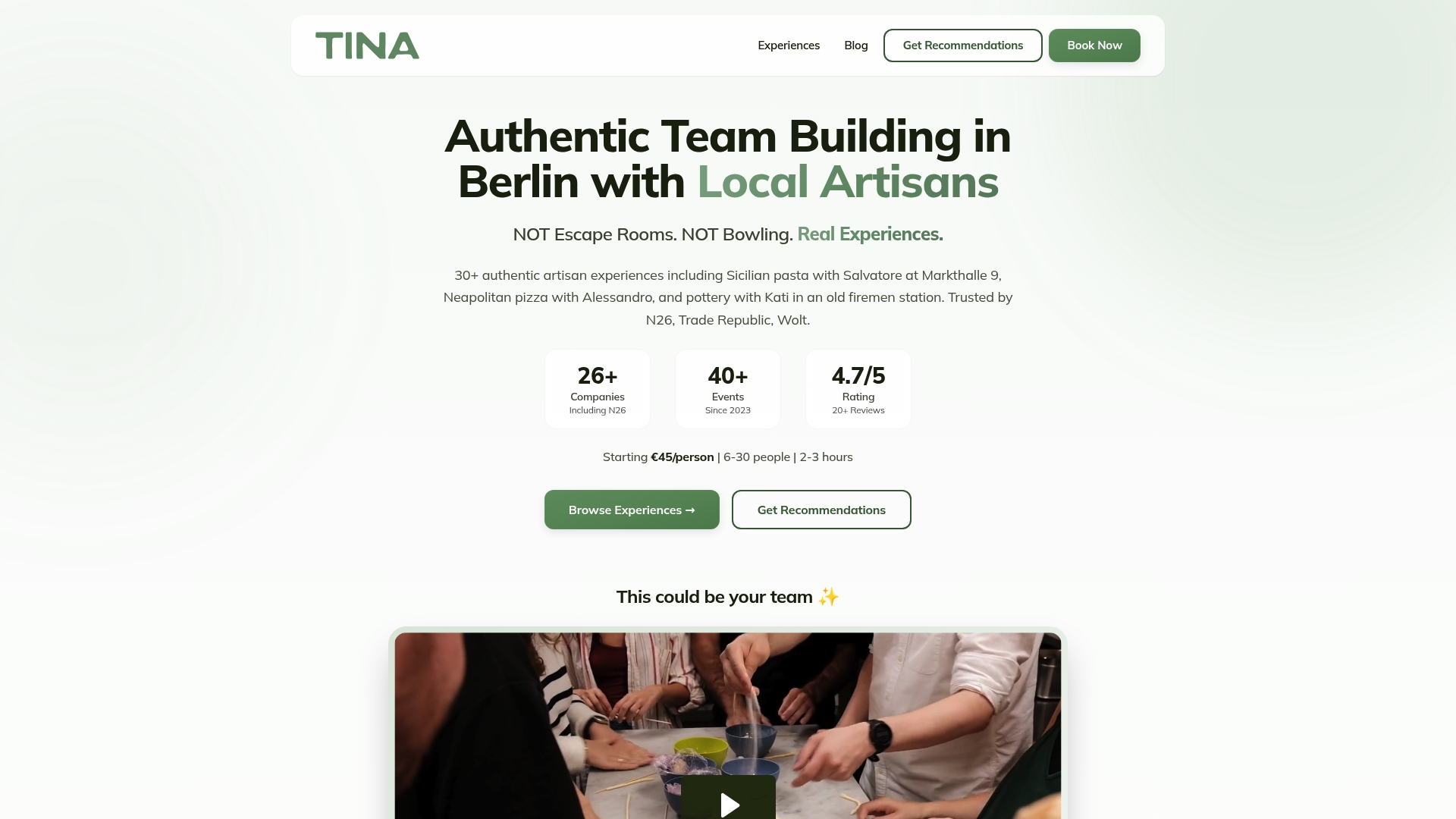
Tinaexperiences connects corporate teams with real Berlin artisans for pottery, pasta-making, foraging, tufting, and more, all in existing venues that need no temporary staging. Companies like N26, Figma, and Wolt have used TINA to run team events that are hands-on, genuinely memorable, and low-waste by design. Over €75,000 has been redistributed directly to local Berlin artisans. The booking process is transparent, the pricing is clear, and there are no hidden agency fees.
For planners who want a sustainable team event without building it from scratch, browse TINA's artisan experiences or check the offsite planning page to see what fits your team size, timeline, and sustainability goals. Request availability directly and get a quote within one business day.
Sources
The certifications and guidance documents below are the ones to reference when vetting venues, briefing suppliers, and reporting event outcomes. Each one is specific, verifiable, and directly applicable to Central Europe event planning.
- Guidelines for the Sustainable Organisation of Events
- Leitfaden nachhaltige Organisation von Veranstaltungen 2021
- Sustainable Event Planning
- Sustainable Event Guidelines | Berlin Convention Office
- Leitfaden für die nachhaltige Organisation von Veranstaltungen
- What Is Local Sourcing: Benefits, Challenges, and Impact – Wild Foodz by Hotel Entree Brugge