

TL;DR:
- Non cringe team building focuses on experiential development that prioritizes psychological safety, adult respect, and measurable outcomes. It employs activities like artisan workshops, debriefs, and low-stakes interactions to foster genuine trust and collaboration without forced vulnerability or hierarchy. Embedding structured, regular practices tailored to team needs creates lasting cultural change and improved performance.
Non cringe team building is defined as deliberately designed group activity that respects adult autonomy, builds psychological safety progressively, and produces measurable improvements in team performance without awkward or forced social moments. The industry term for this practice is experiential team development, and it differs from generic "fun" events by prioritizing real outcomes over entertainment theater. Most corporate teams have sat through a trust fall or a forced icebreaker and felt the collective cringe. There is a better way, and the research behind it is clear.
1. What makes team building non cringe in the first place?
Non cringe team building starts with one design principle: progressive psychological safety. Awkward moments are not random. They are predictable and preventable when you sequence activities from low stakes to higher stakes, building trust before asking for vulnerability. CSz Portland frames this as the core skill of any skilled facilitator.

The second principle is adult respect. Adult-appropriate formats align with genuine connection and real business goals, rather than infantilizing games that drain energy instead of building it. When people feel treated like professionals, they engage. When they feel like they are at a company-mandated summer camp, they disengage and resent the whole exercise.
The third principle is outcome focus. Team building without a clear purpose is just awkward socializing with a budget. Every activity should connect to a real team behavior you want to strengthen, whether that is communication, trust, or creative problem solving.
Pro Tip: Before booking any activity, write one sentence describing the specific team behavior you want to improve. If you cannot write that sentence, the activity is not ready to be booked.
2. Key criteria for choosing the right activities
Not every fun activity qualifies as effective team bonding. Here are the criteria that separate genuine team engagement ideas from cringe-worthy time wasters:
- Low entry barrier. The first activity in any session should require zero personal disclosure and zero skill. Nobody should feel exposed before trust exists.
- Voluntary participation. Forced participation is the single fastest way to generate resentment. Build in genuine opt-out moments.
- Relevance to work. Activities that mirror real collaboration challenges produce behavior transfer. Abstract games rarely do.
- Skilled facilitation. A facilitator who can read the room and name tension without amplifying it transforms discomfort into useful team observations.
- Debrief built in. Regular structured reflection after activities improves team performance by approximately 20 to 25 percent. That number comes from meta-analyses, not anecdote. Skipping the debrief wastes most of the value.
3. Eight activities that deliver without the cringe
Here are eight concrete options that align with non cringe principles, drawn from research and real team experience.
-
Applied improv exercises. Short improv games like "Yes, And" build active listening and spontaneous collaboration. CSz Portland uses these as low-stakes openers precisely because they require no personal disclosure and create shared laughter without embarrassment.
-
This or That. Deel's virtual activity catalog includes this format: a facilitator poses binary choices ("mountains or beach?") and the team responds simultaneously. It reveals personality without pressure and works in five minutes inside an existing meeting.
-
Virtual Scavenger Hunt. Deel's virtual activities are designed to require minimal setup and fit into existing workflows. Scavenger hunts work for remote teams because they create shared mission without physical proximity.
-
Artisan craft workshops. Pottery, tufting, or pasta making with a real artisan puts everyone on an equal learning curve. The CEO and the intern are both beginners with clay. Nobody has a social advantage, and that breaks office hierarchy faster than any icebreaker ever could.
-
Team debrief sessions. Structured reflection after a project or sprint costs nothing and delivers outsized returns. Ongoing teamwork training with interactive participation consistently outperforms passive instruction and one-off social events in improving team behaviors.
-
Show and Tell. Each team member shares one object from their workspace and explains its significance. It is personal without being invasive, and it builds genuine curiosity between colleagues.
-
Collaborative cooking or foraging. Working toward a shared edible outcome creates natural conversation and a tangible result. The shared meal at the end is the debrief.
-
Structured problem-solving challenges. Assign a real but low-stakes work problem to a cross-functional group. The task mirrors actual collaboration, so the skills transfer directly back to the job.
"The best team building activities feel like something you would choose to do on your own. The worst ones feel like something done to you." — CSz Portland facilitation principle
4. Cringe vs. non cringe: a direct comparison
| Traditional activity | Why it creates cringe | Non cringe alternative |
|---|---|---|
| Trust falls | Forced vulnerability before trust exists | Applied improv with zero-disclosure prompts |
| Mandatory icebreakers | Personal questions feel invasive | This or That binary choices |
| Long awkward dinners | No structure, uneven social dynamics | Collaborative cooking with a shared outcome |
| Escape rooms | Competitive pressure exposes hierarchy | Artisan craft workshops with equal learning curves |
| Personality test reveals | Public vulnerability without consent | Structured team debrief with optional sharing |
The pattern is consistent. Cringe comes from forced vulnerability, unclear purpose, and activities that expose hierarchy rather than dissolve it. Non awkward team bonding replaces exposure with shared experience and replaces hierarchy with equal challenge.
5. How to facilitate sessions that actually stick
Facilitation is where most team building programs fail. A great activity run badly produces cringe. A simple activity run well produces genuine connection.
- Start with a facilitation script. Design your session to begin with zero-risk prompts and only escalate difficulty once trust is visible in the room. CSz Portland calls this the core skill of non cringe facilitation.
- Name tension early. If the room feels awkward, say so. "This might feel a little odd at first" defuses discomfort faster than pretending it does not exist.
- Keep early activities short. Short virtual activities of five to fifteen minutes reduce social pressure and fit into regular workflows. The same principle applies in person.
- Connect to leadership clarity. Gallup research shows that leaders with clear excellence definitions have nearly four times higher employee engagement. Team building amplifies what leadership already models. It cannot substitute for it.
- End with a structured debrief. Ask three questions: What happened? What did we learn? What will we do differently? This turns a fun activity into a performance intervention.
Pro Tip: Record one specific behavior change commitment from each team member at the end of the debrief. Follow up on it in the next team meeting. That follow-up is what separates a one-off event from a real culture shift.
6. Choosing the right format for your team's situation
Team bonding and team building are not the same thing. Bonding is about social connection and enjoyment. Building is structured to improve collaboration and communication under pressure. Choosing the wrong format for your team's actual need is one of the most common mistakes team leads make.
- New teams need bonding first. Low-stakes social activities build the baseline trust that makes structured collaboration possible later.
- Established teams benefit more from building activities that challenge existing communication patterns and surface hidden friction.
- Remote and hybrid teams do best with asynchronous or chat-based light activities that reduce social pressure and fit naturally into existing workflows.
- Teams with hierarchy tension need activities where nobody has a skill advantage. Artisan workshops, foraging, and hands-on craft experiences work here because the playing field is genuinely level.
- Budget-conscious teams should prioritize team debriefs and structured reflection as a free, high-return practice, supplemented by occasional experiential events.
One-off events do not build culture. Programmatic approaches, where creative team building is embedded into regular team rhythms, produce lasting behavior change. Think monthly, not annually.
Key takeaways
Non cringe team building works because it combines progressive psychological safety, adult respect, and outcome-focused design rather than forced fun or social pressure.
| Point | Details |
|---|---|
| Start low stakes | Begin every session with zero-disclosure, zero-skill activities before escalating to deeper collaboration. |
| Facilitation is the difference | A skilled facilitator prevents cringe by sequencing trust and naming tension before it builds. |
| Debrief every time | Structured reflection after activities delivers 20 to 25 percent performance gains that skipping the debrief erases. |
| Match format to need | New teams need bonding; established teams need building. Choosing wrong wastes everyone's time. |
| Go programmatic | One-off events do not change culture. Monthly embedded practices do. |
What I have learned from watching teams actually connect
The most honest thing I can tell you is this: the cringe in team building almost never comes from the activity itself. It comes from the gap between what the facilitator asks people to do and the level of trust that actually exists in the room. I have watched teams of thirty people go completely silent during a "fun" icebreaker because the question was too personal too soon. And I have watched those same teams laugh genuinely and work better together after forty minutes of making pasta with a Berlin artisan they had never met.
The reason the pasta workshop worked is not that it was more creative. It is that nobody walked in knowing how to do it. The psychological safety that research consistently identifies as the driver of team performance does not come from a facilitated conversation about feelings. It comes from shared incompetence in a low-stakes environment. When the team lead's pasta falls apart at the same moment as the intern's, something real happens between them.
My honest advice: stop looking for the cleverest activity and start asking what level of trust your team actually has right now. Design from that point, not from the point you wish you were at. And please, no more escape rooms.
— Tina
Real team building in Berlin, without the cringe
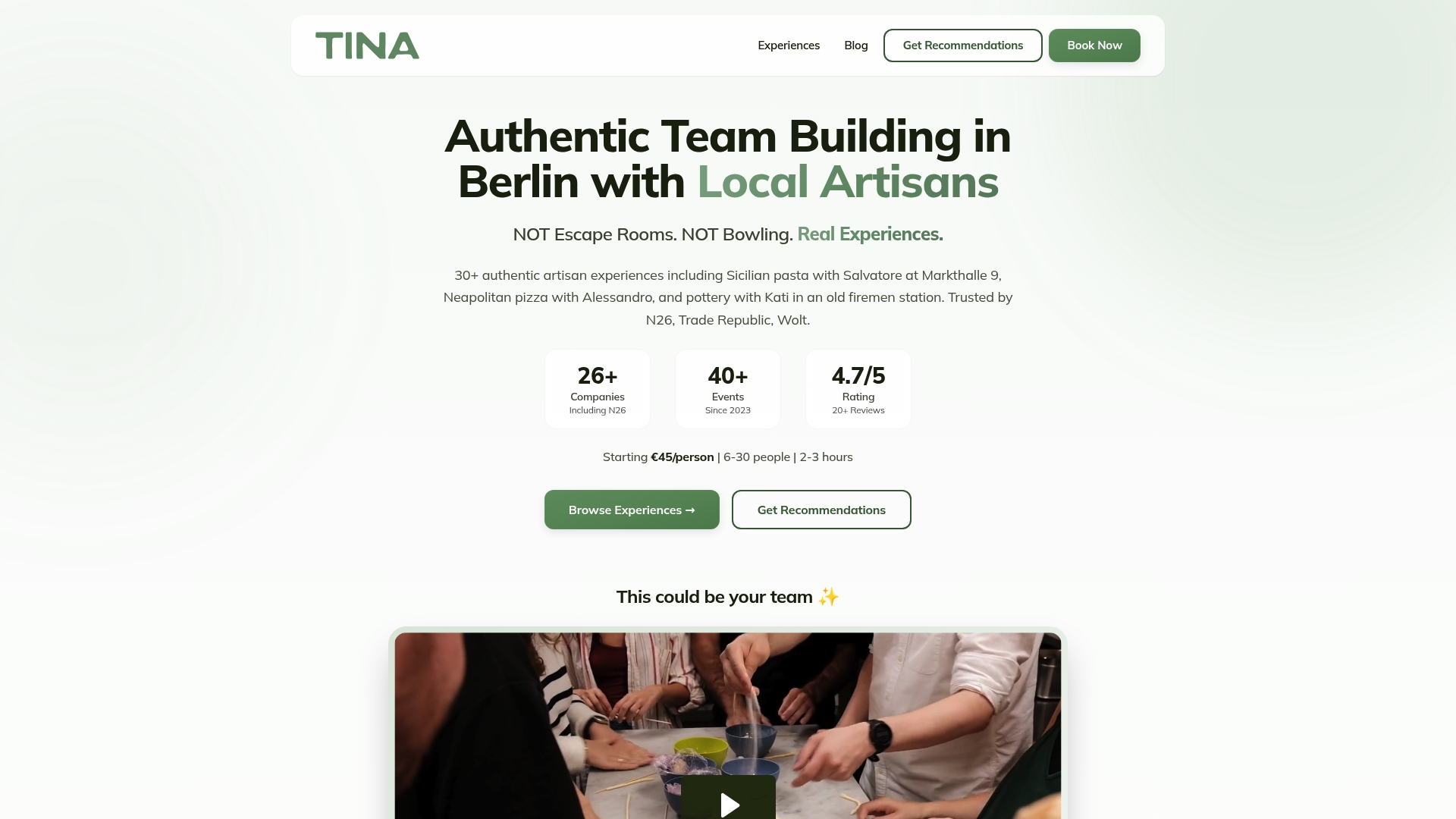
Tinaexperiences connects corporate teams in Berlin with real local artisans for hands-on workshops that break office hierarchy and build genuine connection. Companies like N26, Figma, and Wolt have used Tinaexperiences for pottery, tufting, pasta making, foraging, and more. Every workshop puts the CEO and the intern on the same level because nobody walks in knowing how to throw clay or weave a rug. That equal learning curve is exactly what makes it work. Browse authentic artisan experiences or explore options for your next team offsite directly on the platform. Transparent pricing, real artisans, and no escape rooms.
FAQ
What is non cringe team building?
Non cringe team building is experiential team development designed around progressive psychological safety, adult respect, and clear performance outcomes. It avoids forced vulnerability, infantilizing formats, and activities that expose rather than dissolve office hierarchy.
How long should a non cringe team building session be?
Short activities of five to fifteen minutes work well for virtual teams and fit inside existing meetings. In-person sessions benefit from ninety minutes to two hours, with a structured debrief built into the final twenty minutes.
What is the difference between team bonding and team building?
Team bonding focuses on social connection and enjoyment, while team building is structured to improve collaboration and communication under pressure. New teams need bonding first; established teams benefit more from structured building activities.
Do one-off team events actually improve team performance?
One-off events rarely produce lasting behavior change. Meta-analyses show that ongoing interactive training with regular debriefs outperforms single social events. Embed team building into regular team rhythms for real results.
Why do artisan workshops work better than traditional team building?
Artisan workshops like pottery or tufting create an equal learning curve where no one has a skill advantage. This breaks office hierarchy naturally and builds the kind of psychological safety that research links directly to improved team cooperation and performance.