

TL;DR:
- Effective onboarding creates genuine connection through tactile activities, staged touchpoints, and local support. Combining hands-on artisan workshops, short rituals, buddy programs, and ongoing follow-ups accelerates trust and belonging for international hires. Small, scalable events like virtual kits or low-cost rituals ensure meaningful engagement without heavy budgets or planning.
The most effective new hire welcome event ideas share one quality: they create real connection, not just information transfer. Artisan-led tactile workshops, short all-team welcome rituals, buddy program kickoffs, and a staged sequence of touchpoints across an extended period consistently outperform one-and-done orientation sessions, especially for international hires settling into Central Europe.
TL;DR — five formats that work and why:
- Artisan-led workshop (pottery, tufting, pasta): Everyone is a beginner, so hierarchy disappears. Book for week one.
- Welcome circle or leadership meet-and-greet: Takes 30 minutes, signals that leadership cares, and gives new hires faces to remember.
- Buddy program kickoff: Pairs a new hire with a peer guide on day one. Reduces the "who do I ask?" anxiety that kills early engagement.
- ☕ Coffee roulette (virtual or in-person): Low effort, high return. Randomized pairings build cross-team relationships fast.
- Staged follow-up sequence: A single welcome event is not enough. Wellbeing-first onboarding research confirms that connection-first designs with repeated touchpoints outperform passive, one-time introductions.
For international hires in Germany and Central Europe, layer in local settling resources from the start. Public transport passes, neighborhood guides, language support, and a reference to the Make-it-in-Germany welcome folder signal genuine care early in the onboarding process.
Table of Contents
- Eight quick-pick welcome event formats and when to use each
- Concrete in-person welcome event ideas that are ready to run
- Virtual and hybrid welcome event ideas that actually connect remote hires
- Low-budget welcome ideas you can run today with little prep
- What goes in a new-hire welcome packet (a copyable checklist)
- A copy-and-use 60–90 minute welcome event agenda
- How to estimate costs for welcome events in Central Europe
- Making onboarding human in Central Europe: what the research says
- How to measure success and follow up after the welcome event
- Key Takeaways
- What actually makes a welcome event work
- Why Tinaexperiences is worth booking for your next welcome event
- Useful sources, templates, and planning resources
Eight quick-pick welcome event formats and when to use each
Not every team needs the same format. Here is a fast decision map.
-
Artisan-led tactile workshop — Best for in-person teams of 6–30 people who want a high-impact first impression. Book 2–3 weeks in advance; sessions typically run 90–120 minutes. Pottery, tufting, and pasta-making all work well.
-
Team lunch with intro round — Works for small teams (4–12 people) on a tight timeline. A shared meal with a structured "two truths and a question" format takes about 60 minutes and needs zero lead time.
-
All-hands micro-demo slot — Ideal for larger cohorts or remote-first companies. Give the new hire a 5-minute slot in an existing all-hands meeting to introduce themselves and share one thing they are excited to work on. No extra scheduling required.
-
Onboarding scavenger hunt — Great for office-based teams of 8–25 people. Pairs new hires with existing employees to find people, places, and answers across the building. Plan 2–3 days ahead; runs 45–60 minutes.
-
Virtual coffee roulette — Perfect for distributed or hybrid teams. Tools like Donut (a Slack integration) automate the pairing. Runs continuously with zero ongoing effort after setup.
-
Buddy program launch — Suits any team size and any work model. Assign the buddy before the first day; the kickoff conversation happens in week one. Needs a brief buddy guide document, nothing more.
-
Skills swap session — Works well for teams of 10–20 where cross-functional learning matters. Each person shares a 3-minute skill or tip. Schedule 45 minutes; prep is minimal.
-
Local welcome outing — Especially valuable for international hires new to Berlin or another Central European city. A guided neighborhood walk, a visit to Markthalle Neun, or a local food tour takes 2–3 hours and doubles as settling support.
Concrete in-person welcome event ideas that are ready to run
Artisan-led workshops: the hierarchy equalizer

The single most effective in-person welcome activity for new hires is a hands-on artisan workshop. Pottery, tufting, and pasta-making all share one structural advantage: nobody walks in knowing how to do them. The intern and the VP are both beginners with clay, which means the usual office pecking order has nowhere to land. Research on immersive onboarding confirms that leveling exercises where leaders and new hires learn a craft together reduce status signaling and create candid early rapport.
Practical setup notes:
- Group size: 6–30 people per session works well; most Berlin ateliers accommodate up to 20 comfortably.
- Duration: 90–120 minutes including a short debrief.
- Venue types: Ateliers, market halls (Markthalle Neun is a proven option), secret gardens, or the company's own office if the artisan can travel.
- Lead time: Book 2–3 weeks ahead for standard sessions; 4 weeks for custom or large groups.
- Accessibility: Confirm wheelchair access, seating options for participants who cannot stand for long periods, and whether the activity can be adapted for limited hand mobility. Ask the artisan directly — most are happy to adjust.
Pro Tip: Brief the artisan before the session. Ask them to share a short story about their craft before the hands-on work begins. That two-minute story shifts the room from "corporate event" to "real experience" and gives new hires something to talk about afterward.
Short rituals that scale
Not every team has the budget or time for a full workshop on day one. Short rituals work surprisingly well and take almost no prep.
- Welcome circle: Everyone shares their name, role, and one non-work fact. Cap it at 20 minutes. Works for groups up to 40 if you use a timer.
- Leadership meet-and-greet: A 15-minute open conversation with a senior leader, no slides, no agenda. New hires remember it.
- Team demo slot: Each department gets 3 minutes to show what they actually build or do. Gives new hires a real picture of the company in under 30 minutes.
For team kickoff formats that go deeper, structured icebreakers and scavenger hunts are worth adding. A cross-team scavenger hunt that asks new hires to find specific people and ask them one question builds connections that a slide deck never could.
Accessibility and inclusion checklist
- Collect dietary restrictions and allergies at least 5 days before any food-based activity.
- Confirm venue step-free access and restroom accessibility.
- Offer seated alternatives for any standing activity.
- For sensory-sensitive participants, share the activity format and noise level in advance.
- Provide printed and digital versions of any written materials.
Virtual and hybrid welcome event ideas that actually connect remote hires
Remote and hybrid teams face a specific challenge: the informal moments that build trust in an office simply do not happen by default. You have to design them in.
Four formats that create real connection across distance
-
Virtual coffee roulette: Automated random pairings via Donut or a similar Slack integration. Each pair books a 20-minute video call. No agenda, just conversation. The randomness is the point — it creates connections that would never happen organically.
-
Shipped welcome kit with a guided activity: Send a physical kit to every participant before the event. A simple kit might include a small craft supply set, a local snack from Berlin, and a printed card with the activity instructions. Kit-based events increase participation and create parity between in-person and remote attendees. For inclusive beverage options, include a mocktail or specialty tea alongside any alcoholic items.
-
Hybrid demo plus local hub meetup: The remote cohort joins a shared video call for the welcome and demo segments. Local clusters of 3–5 people meet in a café or co-working space for the social portion. Timed segments (no more than 45 minutes on camera) keep energy up.
-
Micro-learning social: A 30-minute virtual session where one team member teaches a short skill — a keyboard shortcut, a cooking tip, a language phrase. Keeps the tone light and gives everyone something to contribute.
Kit shipping checklist for Central Europe
- Order kits at least 10 business days before the event for domestic Germany shipping; 15 business days for other Central European countries.
- Use a tracked shipping service and confirm delivery before the event date.
- Include a printed agenda card so participants know exactly what to do and when.
- Check customs requirements for non-EU countries within the region (Switzerland, for example).
- Label kits with the participant's name — a small detail that signals personal care.
Platform and facilitation notes
Zoom and Microsoft Teams both support breakout rooms, which are worth using for groups over 10. Put 3–4 people per breakout for the first 10 minutes, then bring everyone back. Keep cameras on during the first activity segment — it matters for connection. For asynchronous alternatives, a shared Miro board where new hires post a photo and three words about themselves works well as a pre-event warm-up.

Time zone considerations: if your Central European team includes hires in Warsaw, Vienna, and Prague alongside Berlin, you are working within a one-hour spread, which is manageable. Schedule the live session between 10:00 AM and 2:00 PM CET to catch everyone at a reasonable hour.
Low-budget welcome ideas you can run today with little prep
Big budgets are not a prerequisite for a warm welcome. These five ideas cost almost nothing and can be ready within 24 hours.
-
Peer welcome lunch potluck: Each team member brings one dish or snack to share. The new hire gets a table full of food and a room full of people who made something for them. Total cost: €0 from the team budget. Action step: send a sign-up message to the team the day before.
-
Desk welcome kit: A handwritten card, a branded notebook, a local snack, and a printed team contact sheet. Takes 20 minutes to assemble. Personal welcome messages are consistently cited as one of the most memorable parts of a first day — the handwritten note matters more than the notebook.
-
Intro email spotlight: Send a short company-wide email introducing the new hire with a photo, their role, one fun fact, and an invitation for colleagues to reach out. Takes 10 minutes to write. Action step: draft the template once and reuse it for every new hire.
-
Team show-and-tell: A 30-minute meeting where each team member shares one thing they are currently working on. The new hire observes and asks one question. No prep required beyond scheduling.
-
Paired coffee walk: Match the new hire with one colleague for a 20-minute walk around the block or the office neighborhood. Walking side-by-side lowers the social pressure of a face-to-face conversation. For activities that work well for introverted new hires, this format is particularly effective.
These quick wins scale naturally. The intro email spotlight becomes a monthly new-hire newsletter. The coffee walk becomes a buddy program. The show-and-tell becomes a weekly team ritual. None of them require a budget line.
What goes in a new-hire welcome packet (a copyable checklist)
A good welcome packet does two things: it removes friction on day one and it signals that the company thought about the person, not just the paperwork. For international hires in Central Europe, the local settling layer is what separates a good packet from a great one.
HR documents and account access
- Signed employment contract copy
- Payroll setup form and bank details submission link
- Tax registration guidance (Steueridentifikationsnummer for Germany)
- Health insurance enrollment confirmation
- IT account credentials and device setup instructions
- Data protection and work safety acknowledgment forms
- Company org chart and team directory
HRM tools with multilingual support and automated document collection reduce the admin burden significantly and help international hires navigate German-language forms without confusion.
Local settling resources for Central Europe hires
- Neighborhood guide for the office area (nearest supermarkets, pharmacies, transit stops)
- Public transport pass or reimbursement instructions (BVG monthly pass in Berlin, for example)
- Language support resources (VHS Berlin courses, Goethe-Institut links, Duolingo for German)
- Make-it-in-Germany welcome folder reference — covering housing, registration, and daily life for international skilled workers
- Local expat community groups or Meetup links relevant to the hire's background
- Emergency contacts and healthcare navigation guide
Regional programs like the Münsterland onboarding resources show that combining company policy with local life information materially helps international hires settle faster.
Culture and team cues
- Buddy assignment with contact details and a suggested first conversation prompt
- Meeting cadence overview (weekly team sync, all-hands schedule, 1:1 rhythm)
- Communication norms (preferred channels, response time expectations, meeting camera policy)
- Key contacts card (IT, HR, office manager, team lead)
- Three to five team rituals or traditions worth knowing about
Pro Tip: Host the digital version of the welcome packet in a single shared link, not scattered across email attachments. A Notion page or a Google Drive folder with clear sections takes 30 minutes to set up and saves every new hire at least an hour of confusion.
A copy-and-use 60–90 minute welcome event agenda
This agenda works for teams of 6–25 people. Two variants are included below.
Variant A: Small team interactive (6–15 people, 75 minutes)
| Time | Segment | Who | Notes |
|---|---|---|---|
| 0:00–0:05 | Welcome and logistics | Host (HR or team lead) | Room setup, housekeeping, agenda overview |
| 0:05–0:15 | Leadership welcome | Senior leader | Informal, no slides — 2 minutes max per leader |
| 0:15–0:35 | Icebreaker or tactile activity | Facilitator or artisan | Welcome circle, scavenger hunt, or craft intro |
| 0:35–0:45 | Team demos | Each team (3 min each) | What we build, what we are proud of |
| 0:55–1:00 | Buddy introductions | Buddy coordinator | Pairs meet for 5 minutes |
| 1:05–1:15 | Wrap, next steps, and Q&A | Host | 30/60/90 plan overview, open questions |
Variant B: Larger cohort orientation (16–40 people, 90 minutes)
- 0:00–0:10 — Host welcome and agenda overview
- 0:10–0:20 — Leadership panel (3 leaders, 3 minutes each, open Q&A for final 1 minute)
- 0:20–0:45 — Breakout icebreakers (groups of 4–5, rotating every 8 minutes)
- 0:45–1:05 — Department showcase (each team gets a 2-minute slot on a shared screen)
- 1:05–1:20 — New-hire spotlight (each new hire shares name, role, and one question for the team)
- 1:20–1:30 — Buddy coordinator closes, distributes buddy assignments, confirms next touchpoint
Roles checklist:
- Host: Owns the agenda, keeps time, handles logistics
- Facilitator: Runs the icebreaker or activity segment
- Tech lead (hybrid/virtual): Manages breakout rooms, screen share, and recording
- Buddy coordinator: Manages buddy assignments and the first buddy check-in
For all-hands engagement tactics that work in larger cohorts, structured breakouts with a clear prompt outperform open networking every time.
How to estimate costs for welcome events in Central Europe
Welcome event budgets vary widely, but the math is straightforward once you break it into components.
Simple estimator formula:
Three example scenarios
-
Artisan workshop in Berlin (15 people): Per-person artisan fee (~€60–€90) + venue (often included or
€100–€200 for a private atelier) + materials (usually included in the artisan fee) + optional catering (€15–€25 per person). Total range: roughly €1,100–€1,750 for the group. Check current pricing and booking options for specific artisan sessions. -
Team lunch with intro round (10 people): Restaurant booking at a Berlin mid-range venue runs €25–€45 per person including drinks. Total: €250–€450. No venue fee, no materials. Lead time: 48 hours.
-
Virtual welcome kit event (20 remote participants): Kit assembly and shipping (~€20–€35 per person for Central Europe domestic) + facilitation time (internal, no fee) + platform (Zoom or Teams, likely already licensed). Total: €400–€700.
| Format | Per-person range | Fixed costs | Best for |
|---|---|---|---|
| Artisan workshop | €60–€90 | €100–€200 venue | In-person teams, week-one impact |
| Team lunch | €25–€45 | None | Small teams, fast turnaround |
| Virtual kit event | €20–€35 | None | Remote or hybrid teams |
| Low-budget rituals | €0–€10 | None | Any team, any timeline |
Compliance training and social activities can share the same day without inflating costs significantly. Scheduling a 30-minute data protection briefing inside the welcome event, rather than as a separate session, saves a calendar slot and reduces the sense of administrative overload for new hires.
Making onboarding human in Central Europe: what the research says
International onboarding in Germany is typically structured across four phases: pre-arrival preparation (2–4 months before the start date), initial legal compliance in the first month, workplace integration across months 2–6, and cultural adaptation from months 6–12. That timeline has direct implications for how you design welcome events and follow-up touchpoints.
A single welcome event on day one is not onboarding. It is the opening of a longer sequence. The practical implication: plan at least several structured touchpoints in the first few months, and keep lighter check-ins running throughout the first year for international hires.
Wellbeing-first onboarding research is clear that designing around human connection rather than administrative throughput creates psychological safety and speeds integration. Passive, lecture-style introductions do not produce the same results, regardless of how thorough the content is.
What actually works in Central Europe:
- Add local resource links (BVG app, Anmeldung guidance, health insurance navigation) to the welcome packet before day one.
- Offer language support proactively — even a list of free German courses signals that the company wants the hire to thrive outside the office.
- Assign a mentor or buddy who is not the direct manager. The OnBoard EU project highlights peer support as a key factor in reducing early turnover in European SMEs.
- Balance mandatory compliance modules with social activities on the same day rather than separating them into different weeks.
Pro Tip: Run an artisan tactile workshop in week one, not week four. The earlier you put leaders and new hires in a room where nobody has an advantage, the faster psychological safety develops. Clay does not care about job titles.
How to measure success and follow up after the welcome event
A welcome event without a follow-up plan is a missed opportunity. Here is what to track and when.
Key success metrics:
- New-hire engagement score at 30 days (pulse survey)
- Buddy check-ins completed (target: at least 3 in the first 30 days)
- Participation rate in the welcome event itself (aim for 100% for small teams)
- 30/60/90-day feedback scores from the new hire and their manager
- 90-day retention rate for the cohort
Two sample pulse survey questions (send at day 30):
- "On a scale of 1–5, how connected do you feel to your team right now?" (1 = not at all, 5 = very connected)
- "Is there one thing we could have done differently in your first month to help you settle in faster?" (open text, one-minute response)
Recommended follow-up cadence:
| Touchpoint | Timing | Owner |
|---|---|---|
| Buddy first check-in | Day 1–3 | Buddy coordinator |
| Manager 1:1 | Week 1 | Direct manager |
| HR pulse survey | Day 30 | HR |
| Team integration check | Day 60 | Team lead |
| Full onboarding review | Day 90 | HR + manager |
| Cultural adaptation check | Month 6 | HR |
| Long-term integration review | Month 12 | HR |
The interactive team-building research shows that structured debriefs after team activities produce measurable performance improvements. Apply the same logic to onboarding: a short debrief conversation at 30 days is worth more than a long survey at 90.
Key Takeaways
The most effective welcome events combine a tactile, hierarchy-breaking activity in week one with staged touchpoints, local settling support, and a buddy program that runs across the first 90 days.
| Point | Details |
|---|---|
| Start with a tactile activity | Artisan workshops in week one neutralize hierarchy and create psychological safety faster than any icebreaker game. |
| Stage touchpoints across 90 days | A single welcome event is not enough; plan buddy check-ins, pulse surveys, and manager 1:1s at 30, 60, and 90 days. |
| Include local settling resources | Welcome packets for Central Europe hires should include transport passes, language support links, and the Make-it-in-Germany folder. |
| Match format to team size and budget | Artisan workshops suit groups of 6–30; team lunches work for small teams fast; virtual kits serve remote cohorts at €20–€35 per person. |
| Use Tinaexperiences for artisan-led events | Tinaexperiences connects Berlin teams with real artisans for pottery, tufting, and pasta-making sessions that break hierarchy and build genuine bonds. |
What actually makes a welcome event work
The conventional wisdom says a welcome event is about information: give new hires the org chart, introduce the leadership team, explain the benefits. That framing is backwards. Information can be sent in an email. What a welcome event actually needs to do is create a moment where a new hire feels like they belong.
The most overlooked insight in onboarding design is that belonging is not produced by warmth alone. It is produced by shared experience under equal conditions. When a new hire and their manager both struggle to center a piece of clay on a wheel, something real happens between them. The status gap closes, not because anyone decided to be egalitarian, but because the activity made it structurally impossible to perform expertise. That is why hands-on team events consistently outperform structured networking and icebreaker games for building early trust.
The second thing most welcome events get wrong is timing. Practitioners often schedule the "fun" event for week three or four, after the compliance modules are done. By then, the new hire has already formed their first impressions, made their first social calculations, and decided who is safe to talk to. Week one is when the hierarchy is most fluid. That is the window to use.
Brief your artisan or facilitator on the group dynamic before the session. Tell them who the new hires are, how many leaders are in the room, and what tone you want. A good artisan reads the room and adjusts — but only if they know what they are walking into.
Why Tinaexperiences is worth booking for your next welcome event
Most welcome events end up being either a slide deck or a dinner where people talk to the colleagues they already know. Tinaexperiences is the alternative that actually changes the dynamic.
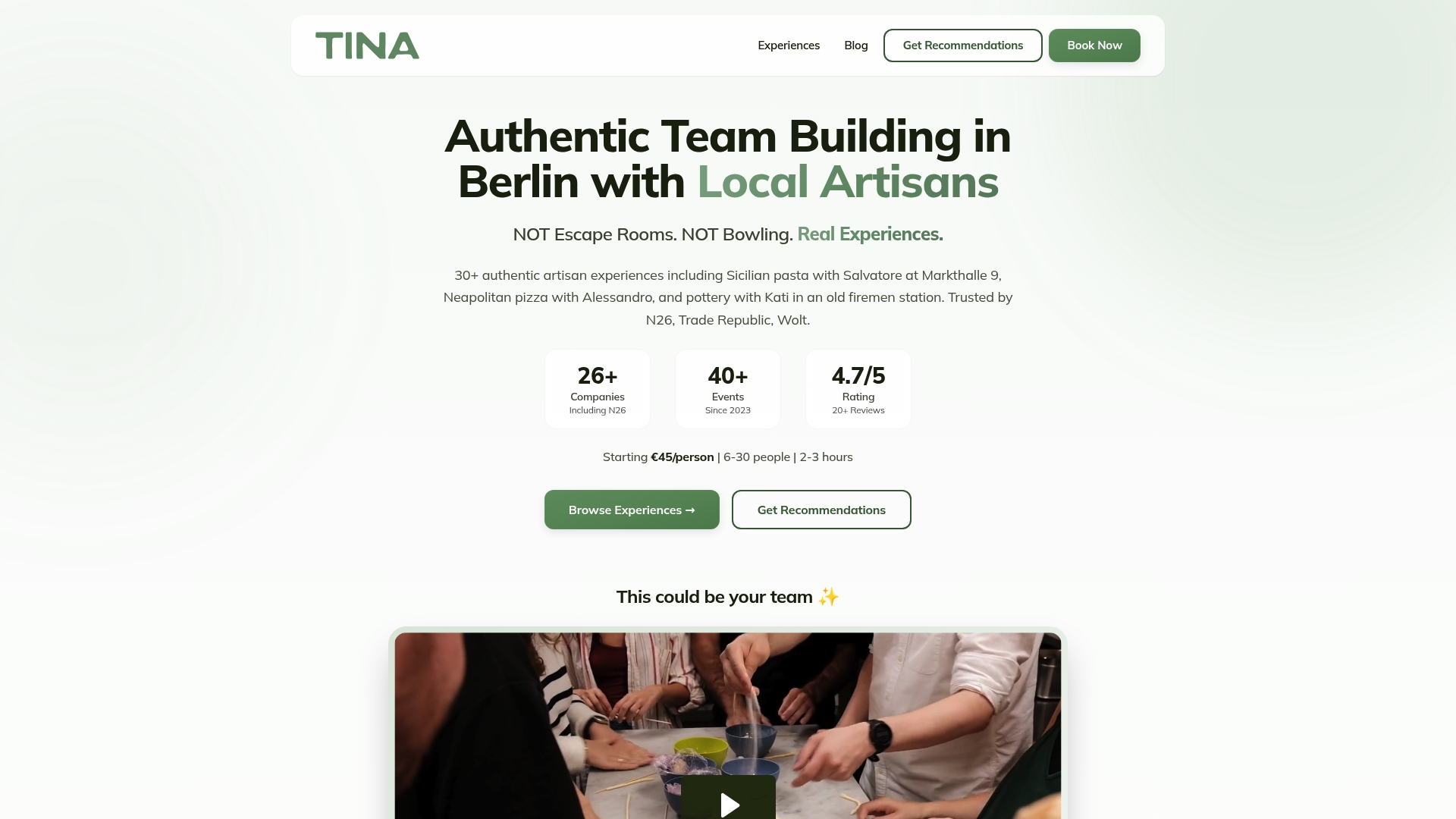
Tinaexperiences connects Berlin-based corporate teams with real local artisans for hands-on workshops — pottery, tufting, pasta-making, chocolate crafting, and more. The platform has completed 40+ events, works with 20+ artisan partners, and has redistributed €75k+ directly to Berlin artisans. Companies like N26, Figma, and Wolt have used it to bring their teams together in a way that no escape room or generic agency event could replicate.
The reason it works for new hire welcome events specifically: the equal learning curve. Nobody walks into a tufting session knowing what they are doing. That shared beginner experience removes the social pecking order and lets real conversations start. Transparent pricing, real-time booking, and detailed artisan profiles make the planning process straightforward. Browse available sessions and book your team's welcome workshop directly on the platform.
Useful sources, templates, and planning resources
The following resources were used in this article and are worth bookmarking for your own planning.
Research and practical references:
- Wellbeing-first onboarding for European hybrid teams — the case for connection-first onboarding design
- Best practices for international employee onboarding in Germany — the 6–12 month phased timeline and compliance integration advice
- Onboarding international specialists in Münsterland — regional welcome folder templates and local settling guidance
- Ideas for team building that actually work, according to science — interactive methods and debrief structures that drive performance gains
- Employee onboarding in Germany with HRM software — automation tools for multilingual document collection and scheduling
- OnBoard EU project — European SME onboarding research and peer support resources
Tinaexperiences planning resources:
- Creative workshops in Berlin — browse artisan-led sessions for welcome events
- Team kickoff event ideas — formats and agendas for short kickoff sessions
- How creative workshops boost teamwork — evidence for workshop-based onboarding
- Company offsites across Europe — multi-day immersive onboarding options
- TINA pricing and booking — transparent pricing for budget planning
Download the sample agenda and welcome packet checklist: The 60–90 minute agenda template and the welcome packet checklist from this article are available as a downloadable PDF. Visit the TINA blog or the team events booking page to access them.