

TL;DR:
- Team event costs vary from $30 for virtual sessions to over $4,000 for multi-day retreats. Infrastructure and group size significantly influence the overall budget, with fixed costs dominating small groups and economies of scale reducing per-person prices. Effective planning requires clear goals, detailed quotes, and budgeting for maximum attendance to avoid costly last-minute changes.
Corporate team event costs range from $30 per person for a simple virtual session to over $4,000 per person for a premium multi-day retreat. That spread is not random. It reflects real differences in format, group size, venue, facilitation, and the services bundled into the price. Understanding how much does a team event cost before you start planning saves you from budget surprises and helps you make a case to leadership. This guide breaks down every cost driver, gives you real pricing benchmarks, and shows you how to build a team event budget that actually holds.
What factors determine the cost of a team event?
The total cost of a team event is the sum of several distinct components. Most planners focus on the activity price and forget that logistics and infrastructure can account for 50–60% of the total event budget. That means the pottery class or pasta workshop you booked may represent less than half of what you actually spend.
The main cost drivers are:
- Activity and facilitation fees. The artisan, instructor, or facilitator charges for their time and materials. This is the number most vendors quote first.
- Venue rental. Ateliers, restaurants, and event spaces charge by the hour or half day. Permits and AV equipment add to this line.
- Food and beverage. Catering costs vary widely. A wine tasting with a full dinner costs far more than a coffee break between sessions.
- Transport and logistics. Getting 40 people to a venue in Berlin adds up fast, especially for off-site locations.
- Add-ons. Prizes, branded merchandise, photography, and contingency buffers all belong in your team event budget.
- Staffing. Event coordinators and support staff are often billed separately from the facilitator.
Fixed costs like venue rental and staffing do not scale with headcount. Variable costs like catering and materials do. That distinction matters a lot when you are deciding between 20 and 40 attendees.
Pro Tip: Request a fully itemized quote that separates activity fees from infrastructure costs. If a vendor gives you a single per-person number, ask them to break it down. You need to know what you are actually buying.

Seasonality also affects pricing. Off-peak bookings can run 10–15% lower than events scheduled during high-demand months. In Berlin, that typically means avoiding december and the spring conference season.
How do team event costs vary by format and group size?
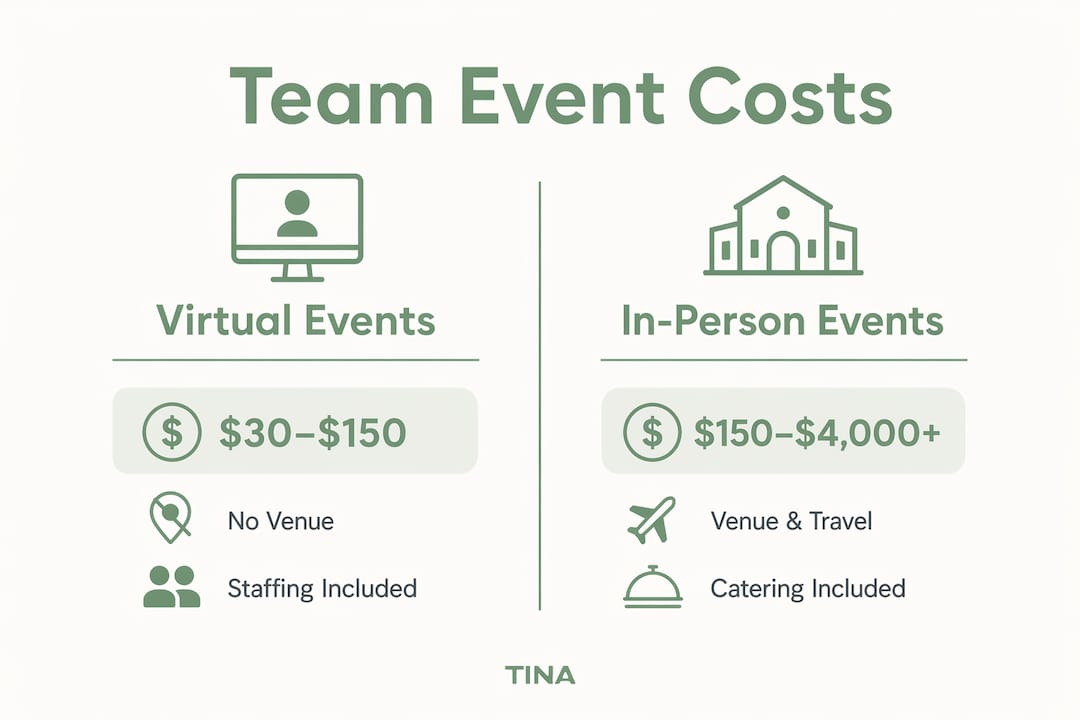
Pricing is not linear. Fixed fees dominate smaller groups, making the cost per person higher. Larger groups spread those fixed costs across more attendees, which brings the per-head rate down significantly.
Here is a practical benchmark table for 2026:
| Event format | Typical per-person cost | What is usually included |
|---|---|---|
| Virtual session | $30–$150 | Facilitator, digital materials, platform |
| In-person local event | $150–$400 | Activity, venue, light catering |
| Full-day in-person event | $400–$800 | Activity, venue, full catering, staffing |
| Premium retreat (multi-day) | $2,000–$4,000+ | Travel, accommodation, meals, facilitation |
Virtual events cost less because they carry no venue or travel overhead. The budget goes almost entirely to staffing and digital materials. That efficiency comes at a cost to bonding quality. Screen-based activities rarely create the same shared memory as a hands-on experience.
For in-person events, group size is the biggest lever you control. Economies of scale can reduce per-head fees by 40–50% when you move from a small group to a large one. A pottery session for 10 people might cost €120 per person. The same session for 40 people at the same venue might cost €70 per person.
Watch for step-function cost increases. Crossing certain headcount thresholds triggers non-linear jumps in price. Adding a 41st attendee might require a second facilitator or a larger venue, which resets your per-person math entirely.
How to budget effectively for a team event
Good budgeting starts with the right number. Always plan against your maximum likely attendance, not your expected attendance. Budgeting for maximum headcount protects you from the cost jumps that happen when you add people at the last minute.
Follow these steps to build a budget that holds:
- Define your cultural outcome first. Are you trying to break down hierarchy? Build cross-team relationships? Celebrate a milestone? The answer shapes which format and price tier makes sense.
- Separate activity costs from infrastructure costs. Segmenting these two buckets lets you see exactly where trade-offs are possible.
- Get line-item quotes from vendors. A single per-person number hides too much. Ask for venue, facilitation, catering, and logistics as separate figures.
- Add a 10–15% contingency buffer. Last-minute additions, dietary requirements, and AV issues are predictable surprises.
- Consider off-peak timing. Booking in january, february, or early november in Berlin often unlocks better rates and venue availability.
- Choose lean or premium. Avoid the middle. Companies increasingly polarize between low-cost and high-investment approaches. A half-hearted mid-budget event often delivers neither the savings nor the impact you want.
Pro Tip: The best workshop-based team events deliver cultural value that outlasts the event itself. Budget for that outcome, not just the activity.
Common misconceptions that blow team event budgets
The biggest mistake HR managers make is treating a per-person quote as the final number. Hidden fixed costs like service fees, staffing, and logistics regularly push the real total well above the quoted price.
Watch out for these specific pitfalls:
- Assuming the activity price covers everything. It rarely does. Venue, catering, and coordination are almost always separate.
- Ignoring fixed staffing fees. A coordinator who costs €500 flat is cheap for 50 people and expensive for 10.
- Choosing an event based on price alone. An activity that costs less but produces no real bonding is not a bargain. Successful planners prioritize cultural outcomes over cost metrics.
- Skipping the headcount buffer. If your team grows from 38 to 42 before the event, you may need a larger venue and a second facilitator.
- Forgetting about the step-cost threshold. That extra facilitator or bigger room can add hundreds of euros to your total without warning.
The average team event pricing you see online is almost always a floor, not a ceiling. Build your budget from the top down, not the bottom up.
Key takeaways
Team event costs are driven by format, group size, and the split between activity fees and infrastructure, with per-person prices ranging from $30 for virtual sessions to over $4,000 for premium retreats.
| Point | Details |
|---|---|
| Cost range by format | Virtual events start at $30 per person; premium retreats exceed $4,000 per attendee. |
| Infrastructure dominates | Venue, catering, and logistics can account for 50–60% of the total budget. |
| Group size changes math | Economies of scale can cut per-person costs by 40–50% as headcount grows. |
| Budget for maximum attendance | Step-cost thresholds make last-minute additions expensive; plan for your upper headcount. |
| Define outcomes first | Planners who start with cultural goals make better spending decisions than those who start with price. |
What I have learned about spending wisely on team events
The question HR managers ask me most often is: "What is a reasonable budget?" My honest answer is that the budget question is the wrong starting point. The right question is: "What do you want your team to feel and do differently after this event?"
I have seen companies spend €400 per person on a catered dinner where people sat with their own departments all night. I have also seen €80 per person spent on a pasta-making session at a real Berlin atelier where the CFO and the newest hire were both covered in flour, laughing at the same mistake. The second event created something the first one never could.
Tactile, hands-on experiences work because nobody walks in as an expert. When your team is learning to throw clay or hand-roll pasta with a real artisan, the office hierarchy disappears. The intern and the team lead are on the same level. That equality is what creates genuine connection, and it is very hard to manufacture with a catered buffet.
My practical advice: pick a clear cultural goal, separate your activity costs from your logistics costs, and do not settle for the middle-ground budget that delivers neither savings nor impact. If you are going to invest in your team, make it count.
— Tina
Tinaexperiences makes team event budgeting straightforward
Planning a team event in Berlin does not have to mean hours of vendor calls and opaque pricing.
Tinaexperiences connects you directly with real Berlin artisans for hands-on experiences like pottery, pasta-making, tufting, foraging, and wine tasting. Every event comes with transparent pricing and automated invoicing, so you know exactly what you are paying for before you confirm. Companies like N26, Figma, and Wolt have used Tinaexperiences to run authentic events that teams actually remember. Browse the full catalog of Berlin team events and get a clear cost picture in minutes.
FAQ
How much does a team event cost per person on average?
Per-person costs range from $30–$150 for virtual sessions, $150–$400 for in-person local events, and $2,000–$4,000 or more for premium multi-day retreats. The final number depends on group size, venue, catering, and facilitation.
Why does the per-person cost drop for larger groups?
Fixed costs like venue rental and staffing are spread across more attendees as group size grows. Economies of scale can reduce per-head fees by 40–50% when moving from a small group to a large one.
What hidden costs should I watch for in a team event budget?
Venue rental, AV equipment, catering, staffing, and transport are frequently excluded from per-person activity quotes. These infrastructure costs can account for 50–60% of the total event budget.
When is the cheapest time to book a team event?
Off-peak months typically offer 10–15% lower pricing compared to high-demand periods. In Berlin, january, february, and early november tend to offer better rates and venue availability.
What is the most cost-effective type of team event for bonding?
In-person hands-on workshops deliver the strongest bonding outcomes relative to cost. Tactile activities like pottery or pasta-making create equal learning conditions that break office hierarchy and build genuine connection.