

TL;DR:
- Authentic team building focuses on ongoing, trust-based processes rather than one-time activities.
- Creative, purpose-driven experiences in Berlin foster lasting connections and team performance.
- Consistent, culturally rooted activities significantly boost engagement, motivation, and collaboration.
Most teams in Berlin have been through the classic circuit: the escape room, the cocktail night, maybe a boat trip along the Spree. Everyone has a decent time, and then Monday arrives and nothing has changed. That gap between "fun afternoon" and "real team transformation" is exactly what this guide addresses. One-off recreational activities provide temporary morale but no lasting change. If you're an HR manager or team leader ready to do something that actually sticks, read on.
Table of Contents
- What authentic team building really means
- Frameworks and models behind authentic team building
- The true impact: Beyond morale to motivation and engagement
- When 'fun' isn't enough: The limits of recreation and the power of experience
- Why authentic team building means committing to culture, not quick fixes
- Experience authentic team building in Berlin
- Frequently asked questions
Key Takeaways
| Point | Details |
|---|---|
| Continuous process | Authentic team building is an ongoing commitment, not a one-time event. |
| Frameworks matter | Proven models like Tuckman and GRPI guide teams toward genuine trust and collaboration. |
| Measured impact | High-trust teams achieve much greater motivation and engagement. |
| Beyond 'fun' | Meaningful experiences produce lasting change; superficial events do not. |
| Cultural fit | Authenticity is enhanced when team building aligns with local context and culture. |
What authentic team building really means
With the challenge to old approaches clear, it's essential to understand what truly sets authentic team building apart.
Most people use "team building" as a catch-all for any group activity outside the office. But genuine team building is something different. It's not a one-afternoon fix. It's an ongoing, intentional strategy that shapes how people relate to each other every day.
Authentic team building emphasizes genuine, ongoing processes over superficial one-off events, focusing on self-awareness, relational transparency, and structured activities that align with team needs to foster trust and collaboration. That's a mouthful, but the idea is simple: the goal is real connection, not just a shared memory.
Here are the core pillars that separate authentic team building from generic corporate fun:
- Trust: People feel safe enough to be honest, to ask for help, and to admit mistakes without fear.
- Self-awareness: Team members understand their own strengths, triggers, and blind spots, and how these affect others.
- Relational transparency: There's openness about intentions, goals, and concerns, not just surface-level politeness.
- Ongoing structure: Activities are repeated and evolve over time, rather than being a one-time checkbox.
- Alignment with team needs: Every activity connects back to real challenges the team faces, not a generic program lifted from a catalog.
"The difference between a forgettable team day and a genuinely transformative experience is whether people leave knowing each other a little better and trusting each other a little more."
Traditional approaches focus on recreation because it's easy to organize and easy to sell. But recreation doesn't challenge assumptions, surface hidden tensions, or build the kind of relational depth that makes teams perform. Authentic team building in Berlin means going further, connecting people through shared creative effort, real skill challenges, and experiences that level the playing field.
Frameworks and models behind authentic team building
Now that the core concepts are clear, let's explore the trusted frameworks that bring authentic team building to life.
Frameworks give structure to what can otherwise feel vague. Three models stand out as the most widely used and practically useful.
Core methodologies include Tuckman's stages, GRPI, and Katzenbach-Smith essentials, each offering a different lens on team dynamics.
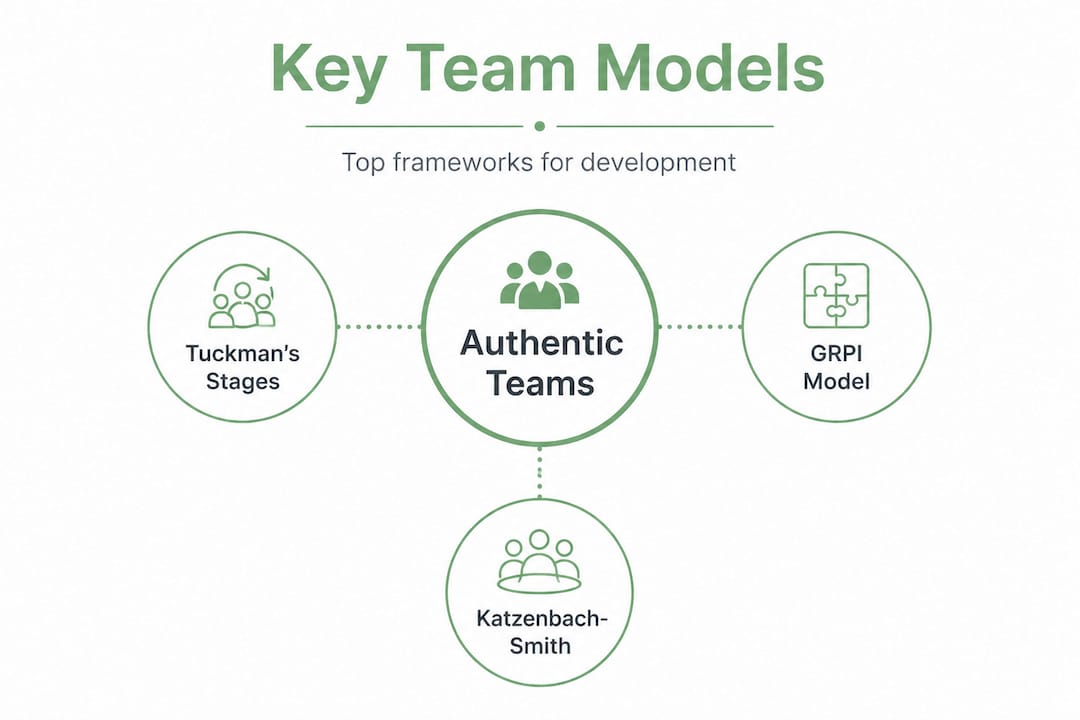
| Framework | Core idea | Best used for |
|---|---|---|
| Tuckman's stages | Forming, Storming, Norming, Performing | Diagnosing where a team is in its development |
| GRPI model | Goals, Roles, Processes, Interpersonal | Identifying the root cause of team friction |
| Katzenbach-Smith | Complementary skills, common purpose, mutual accountability | Building high-performance team culture |
Here's how you can apply a framework practically:
- Assess your team's stage. Use Tuckman's model to identify whether your team is still forming (getting to know roles), storming (navigating conflict), norming (settling into patterns), or performing (operating at full capacity).
- Diagnose the real problem. Apply the GRPI lens. Are goals unclear? Are roles ambiguous? Is conflict interpersonal rather than process-based? The answer shapes what kind of activity will actually help.
- Design the experience around the gap. If trust is the core issue, choose an activity that naturally equalizes status and requires cooperation, like a hands-on craft workshop where nobody has prior experience.
- Debrief intentionally. After any workshop-based team event, hold a short structured reflection. What did people notice about how they communicated? What surprised them?
- Repeat and evolve. One session won't shift a culture. Plan a rhythm of experiences across the year.
Pro Tip: Use a framework as a diagnostic tool, not a rigid prescription. Frameworks show you where to look, not exactly what to do. The best team building blends structure with genuine human moments.
The true impact: Beyond morale to motivation and engagement
Equipped with frameworks, it's important to see how authentic team building affects your team in measurable ways.
The business case for authentic team building is stronger than most people realize. It's not just about a good mood on a Friday afternoon.
Empirical benchmarks tell a clear story: employees in high-trust teams are 260% more motivated, and purpose-aligned employees are 5.6x more engaged according to Gallup research. A 281-team experiment found that leadership encouragement and consistent team development activities substantially boosted performance across the board.
There's also an important distinction to keep in mind: training improves individual skills, while team building improves relationships. Both matter, but they're not interchangeable. A coding workshop teaches coding. A creative craft session where your head of finance and your newest junior designer have to figure out pasta shapes together? That builds something that no skills course can replicate.
Here's what the team building impact looks like in practice for Berlin teams:
- Reduced silos: When people work side by side on something unfamiliar, they naturally communicate across department lines.
- Increased psychological safety: Shared vulnerability (nobody is good at kneading dough on their first try) makes it easier to admit uncertainty at work too.
- Better collaboration on real projects: Teams that have shared creative experiences report fewer misunderstandings and more proactive communication.
- Stronger retention signals: Employees who feel genuinely connected to their colleagues are less likely to leave.
Pro Tip: Consistency beats intensity. A quarterly hands-on experience does far more for your team culture than one elaborate annual retreat. Small, regular investments in relational connection compound over time.
When 'fun' isn't enough: The limits of recreation and the power of experience
While results are promising, not every activity genuinely transforms a team, so what makes experiential approaches different?
Short-term recreational activities have their place. A summer BBQ creates goodwill. A trivia night is enjoyable. But research is clear that one-off recreational activities provide temporary morale but no lasting change. High variability in team diversity may actually hurt short-term performance in purely social settings, while atypical diversity enhances team viability when the experience is purposeful and structured. Post-merger teams, for example, carry real tension that a game of bowling will not resolve. Those situations often need what researchers call somatic methods, shared physical experiences that bypass the analytical mind and create genuine connection at a human level.
| Recreational activity | Experiential, purpose-driven activity |
|---|---|
| Fun but passive | Engaging and hands-on |
| No skill challenge | Gentle challenge that equalizes the group |
| Forgettable after a week | A story you tell for months |
| Reinforces existing social hierarchies | Levels the playing field for everyone |
| One-off event | Designed to repeat and build over time |
"When the intern and the team lead are both struggling to center a piece of clay on a pottery wheel, rank disappears. That's when real conversation starts."
Berlin's cultural scene is genuinely unique. The city has a living tradition of craft, art, and independent makers. That context matters. Experiential team building in Berlin can tap into something real: local artisans with genuine stories, workshops in ateliers that have their own energy, hands-on skills that feel meaningful rather than manufactured.
Creative workshops and teamwork have a documented connection too. Creative tasks activate different neural pathways than everyday work, which helps people see their colleagues in a new light and break out of rigid professional roles. The result is a team that knows each other as people, not just job titles.
Why authentic team building means committing to culture, not quick fixes
With all this in mind, here's a candid take on what actually works if you're aiming for authentic results.
Quick fixes are appealing because they're easy to justify. You book something, you tick the box, and you move on. But that approach treats culture as an event rather than a living thing. Lasting change happens when your team builds a shared routine of reflection, honest conversation, and real experience. It doesn't have to be grand. A quarterly craft workshop followed by a simple debrief is more powerful than an annual team retreat that everyone forgets by February.
Berlin offers something special here. The city's identity is built on authentic creativity, and your team building strategy should reflect that. The Berlin team bonding approach that works is one rooted in the local culture, repeated with intention, and genuinely enjoyed rather than endured. Ask yourself honestly: does your current approach build something that lasts, or just fill an afternoon?
Experience authentic team building in Berlin
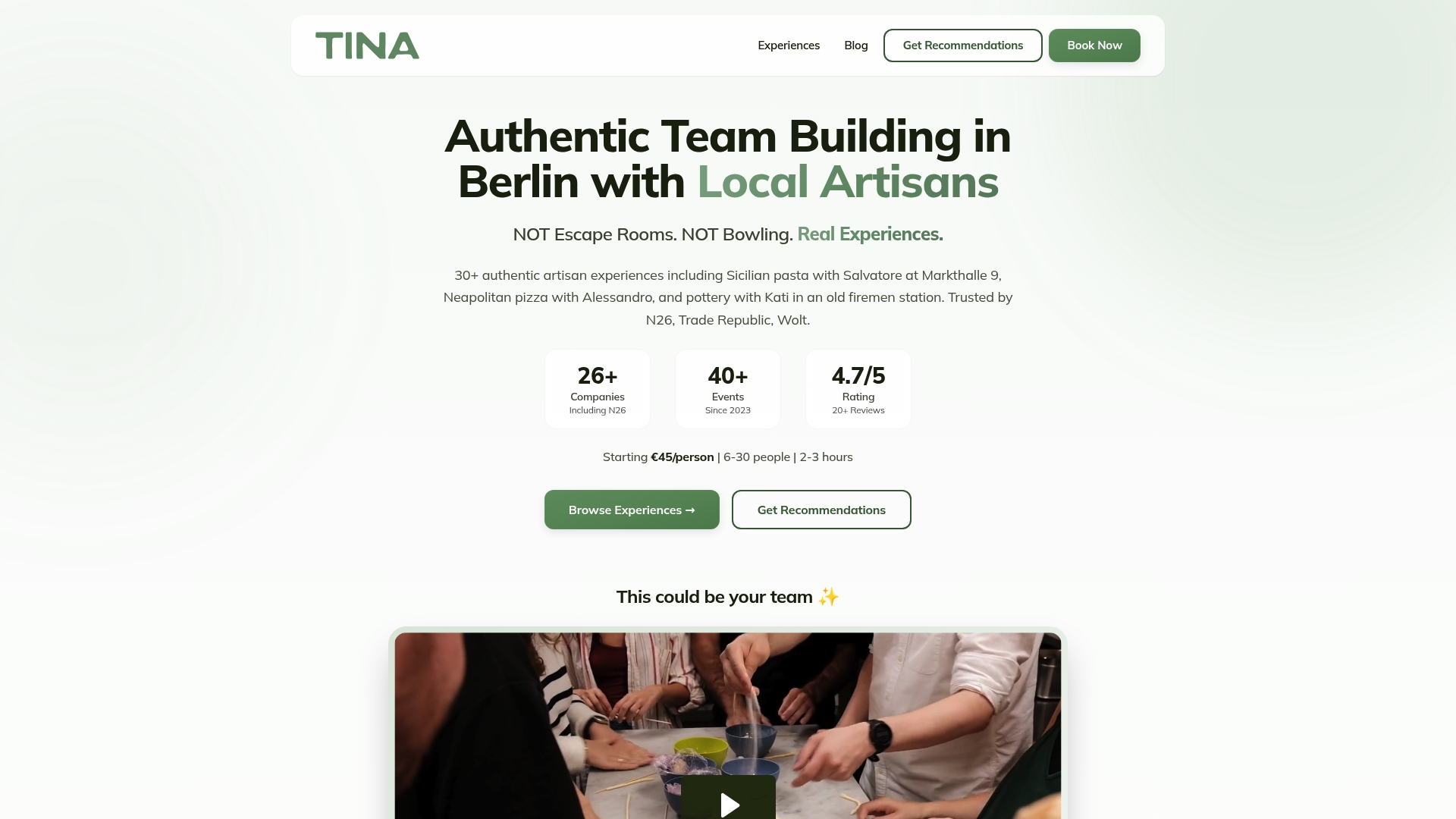
Ready to move your team from one-off events to real transformation? TINA connects Berlin teams with real local artisans for hands-on creative workshops, from pasta making and pottery to chocolate crafting and sustainable merchandise. These aren't generic activities. They're genuine, cultural experiences that naturally level the playing field and help people connect.
Browse authentic team building activities for your Berlin team, plan your team offsite with expert support, or explore creative workshops in Berlin and find the experience that fits your team's culture and goals.
Frequently asked questions
How is authentic team building different from team bonding?
Authentic team building focuses on ongoing, purpose-led processes and fostering deep trust, while team bonding often centers on short-term morale boosters. Authentic team building emphasizes genuine, ongoing processes over superficial one-off events, making it a fundamentally different and more impactful strategy.
Do one-off recreational events help team performance?
While they may boost morale temporarily, they do not create lasting change or deep trust. Research confirms that one-off recreational activities provide only short-term morale improvement with no sustained impact on team performance or culture.
Which models are most used in authentic team building?
Tuckman's stages, the GRPI model, and Katzenbach-Smith's essentials are the most widely applied frameworks. Core methodologies include Tuckman's stages, GRPI, and Katzenbach-Smith essentials, and each framework serves a distinct diagnostic and planning purpose.
Does authentic team building improve engagement?
Significantly. Empirical benchmarks show that employees in high-trust teams are 260% more motivated and purpose-aligned employees are 5.6x more engaged, making authentic team building one of the highest-return investments a company can make in its people.