
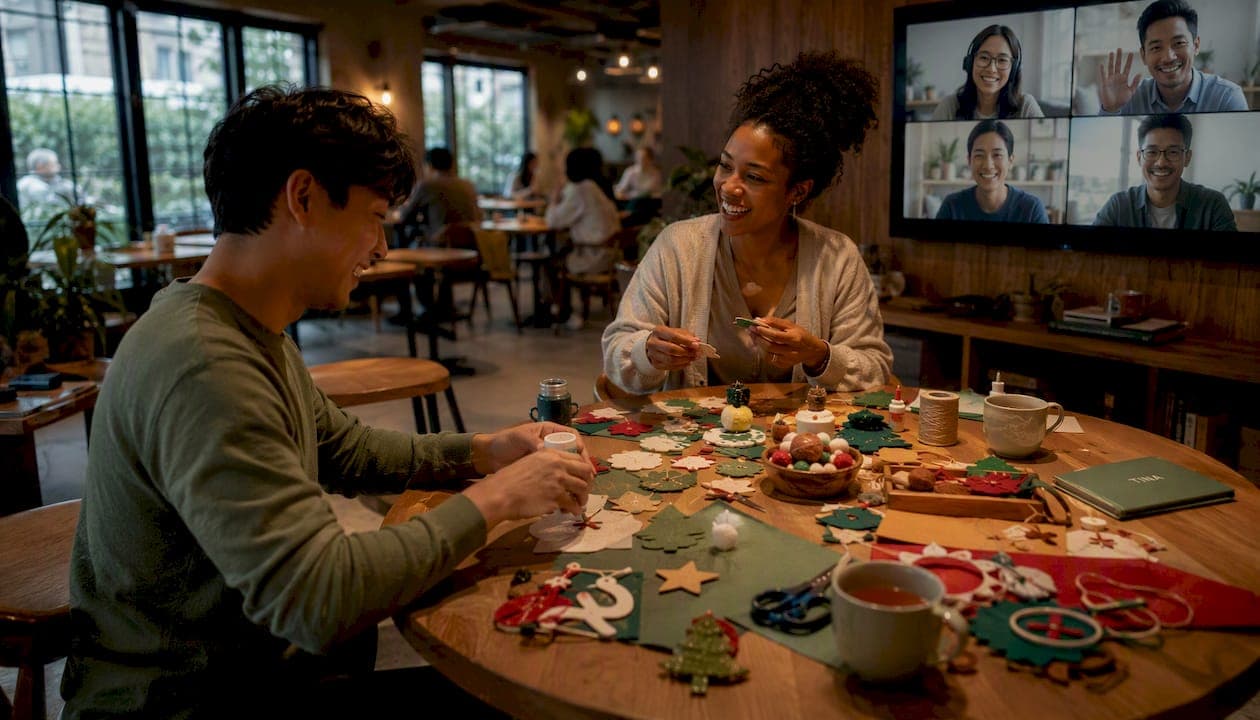
The best alternative Christmas party ideas for corporate teams, ranked by real impact: hands-on artisan workshops (pottery, pasta making, tufting, chocolate crafting), immersive theatre or murder mystery, interactive food and cooking workshops, micro festival or makers fair, low-key creative socials, charity or volunteering experiences, active outdoor winter adventures, and digital hybrid kits with a live host. For most teams, start with a hands-on artisan workshop. The reason is simple: tactile formats flatten office hierarchy because the CEO and the intern are equally bad at throwing clay on day one, and that equal learning curve creates genuine psychological safety that a dinner or escape room never will.
- Artisan workshops (pottery, tufting, pasta, foraging): highest bonding ROI, any team size
- Immersive theatre or murder mystery: high energy, great for extroverted teams
- Interactive food workshops (live cooking, pizza, chocolate): doubles as catering and activity
- Micro festival or makers fair: works well for large groups of 50 or more
- ☕ Low-key creative socials (zine making, plant workshops, life drawing): low pressure, high inclusion
- Charity or volunteering integration: strong for purpose-driven company cultures
- ️ Active outdoor winter adventures (winter hiking, ice skating, forest bathing): great for sporty teams
- Digital hybrid kits with a live host: the right fallback for distributed or budget-constrained teams
If your budget is tight or your team is fully remote, the hybrid kit format is a solid fallback. Tinaexperiences offers curated artisan workshops across Central Europe, with transparent pricing and real Berlin artisans, making it the easiest starting point for planners who want something genuinely memorable.
Pro Tip: Book your preferred format at least 8 weeks out for December dates in Berlin, Vienna, or Prague. Artisan venues and private dining rooms fill up fast from October onward.

Table of Contents
- What kind of alternative party format fits your team's goals?
- How do you choose the right format for your team?
- What venues and catering formats work best for experiential parties?
- How do you run a virtual or hybrid alternative party well?
- Why do hands-on experiential events actually work?
- Key Takeaways
- The case for doing something real
- Tinaexperiences makes booking an artisan Christmas party straightforward
- Useful sources for planners
What kind of alternative party format fits your team's goals?
The format you pick should match the outcome you actually need, not just the one that sounds fun in a planning meeting. Here is how the main categories break down.

Experiential hands-on workshops
Think pottery, tufting, pasta making, chocolate crafting, or jewelry making with a real artisan. These work because interactive, hands-on activities outperform passive formats on task cohesion and role clarification. Best for teams of 8–40 people. Accessibility note: all seated formats, no physical fitness required. Alcohol optional and easy to drop entirely.
- Pottery with a Berlin ceramicist: everyone leaves with a piece they made; nobody leaves feeling like the "winner"
- Tufting workshop: teams design and weave a rug panel together, a literal artifact of collaboration
- Pasta or pizza making with a local chef: combines activity and dinner in one booking, no separate catering needed
Immersive theatre and role play
Murder mysteries, escape narratives, or interactive theatre performances where the team becomes part of the story. High energy and great for extroverted groups. Works best for 15–60 people. Accessibility consideration: some formats require movement; always confirm with the venue. Alcohol is common at these events but easy to make optional.
- Bespoke murder mystery dinner: a professional cast, your team as suspects, a private dining room
- Immersive escape narrative (not a standard escape room): story-led, actor-guided, no padlocks
- Improv comedy workshop: teams learn basic improv rules and perform short scenes; surprisingly effective for communication skills
Culinary and tasting workshops
Interactive food experiences and live cooking formats are among the most popular non-traditional Christmas celebrations because they double as both activity and meal. Best for 10–50 people. Always collect dietary restrictions in advance; most formats can accommodate vegan and gluten-free guests.
- Live sushi or ramen masterclass: a chef teaches technique, teams cook and eat together
- Chocolate crafting and tasting: hands-on, low mess, universally loved, and easy to ship as a hybrid kit
- Wine or cocktail tasting with a sommelier: works well as a lower-intensity social format
Small festival, market, or makers fair
Rent a market hall or large atelier and set up rotating craft stations, food stalls, and a live music corner. Ideal for large groups of 50 or more. Venues like Markthalle Neun in Berlin or similar market halls in Vienna and Prague are built for exactly this format.
- Internal makers fair: each department runs a craft or food station, teams rotate
- Winter market with local vendors: bring in three or four artisans and let the team shop, learn, and eat
- Themed pop-up with a single craft focus (e.g., candle making, wreath building): lower logistics, higher cohesion
Low-key creative socials and micro interactions
Not every team wants a big production. Zine making, plant potting, life drawing, or a guided book swap are genuinely fun holiday activities that feel low-pressure and inclusive. Best for smaller teams of 6–20 or as a breakout within a larger event.
- Zine or collage workshop: teams create a collective publication; no artistic skill required
- Guided plant or terrarium workshop: tactile, calming, and everyone takes something home
- Life drawing with a twist: a clothed model in a festive costume, a local artist teaching basics
Pro Tip: Low-key formats are the best choice when your team has mixed energy levels, new joiners, or a history of awkward forced fun. The lower the stakes, the more genuine the interaction.
Outdoor active adventures
Winter hiking, ice skating, forest bathing, or a guided foraging walk. Works well for physically active teams and pairs naturally with a warm meal afterward. Central European cities offer excellent options: the Grunewald forest in Berlin, the Vienna Woods, or the hills around Prague.
- Guided foraging walk followed by a cooking session: from forest to table in one afternoon
- Group ice skating with a private rink session: classic, accessible, and genuinely festive
- Winter hiking with a fire-cooked lunch: high effort, high reward, best for teams that already spend time outdoors
Volunteering and charity integrations
Purpose-driven companies often find that a volunteering afternoon lands better than any party. Teams pack food parcels, restore a community garden, or run a craft workshop for a local charity. Best for 10–80 people and easy to scale.
- Community kitchen session: cook and donate meals to a local shelter
- Craft workshop for a children's charity: make decorations or gifts together, donate the output
- Habitat restoration morning followed by a team lunch: physical, meaningful, and memorable
Digital hybrid kits with a live host
For distributed teams or tight budgets, ship a craft or cocktail kit to each participant and run a live hosted session over video. Chocolate making, cocktail mixing, or a guided drawing session all translate well. Best for teams of 10–100 across multiple locations.
- Shipped cocktail or mocktail kit with a live mixologist: everyone mixes together in real time
- Distributed chocolate or pasta kit with a video artisan: the same hands-on format, delivered to home offices
- Digital game show with a live host: social gaming platforms like Kahoot or Jackbox work well for pure entertainment
How do you choose the right format for your team?
Use this checklist before you brief any supplier. It takes five minutes and saves weeks of back-and-forth.
Planning checklist
- Goal: Is this primarily celebration, bonding, skills building, or community impact?
- Team size: Under 20, 20–50, or 50 or more? Some formats do not scale.
- Budget per person: Low (under €30), mid (€30–€80), or premium (€80 or more)?
- Accessibility needs: Any mobility, sensory, or dietary requirements?
- Alcohol policy: Fully dry, optional, or central to the format?
- Dietary restrictions: Collect these before shortlisting any food format.
- Location constraints: Office, external venue, or fully remote?
- Hybrid requirements: Do remote participants need to join live?
- Fallback plan: What happens if the venue cancels within two weeks?
One-page vendor brief template
Copy and paste this when briefing suppliers:
Event objective: [celebration / bonding / skills / community] Headcount: [number] confirmed, [number] estimated Date or window: [specific date or range] Site needs: [private room / outdoor / in-office / hybrid-ready] AV and technical needs: [projector / PA / video conferencing] Dietary notes: [vegan / gluten-free / halal / allergies] Success metric: [what does a great event look like for your team?]
Typical cost ranges and planning timelines for Central Europe
In-city team building formats have grown sharply in demand, with budgets for groups of 40–70 people commonly falling between €2,000 and €10,000.
| Budget tier | Per-person range | Best formats | Planning window |
|---|---|---|---|
| Low | Under €30 | Hybrid kits, low-key creative socials, volunteering | 2–4 weeks |
| Mid | €30–€80 | Artisan workshops, culinary sessions, immersive theatre | 4–8 weeks |
| Premium | €80 or more | Private artisan atelier, fine dining with chef, micro festival | 8–12 weeks |
Sample timelines:
- 8–12 weeks out: Confirm format and venue, collect dietary and accessibility data, send save-the-date, brief supplier with full vendor brief.
- 4 weeks out: Confirm headcount, finalize catering, arrange transport and coat storage, confirm AV needs.
- 2 weeks out: Send final numbers, confirm dietary requirements, brief internal communications, arrange a backup plan.
Pro Tip: For January celebrations, your planning window shrinks to 3–4 weeks because venues reopen with availability. January parties are cheaper, less crowded, and often better attended because people are not already overcommitted.
What venues and catering formats work best for experiential parties?
Venue choice makes or breaks an experiential event. A neon-lit conference room kills the mood for a pottery session; a real atelier makes it feel like an adventure.
Venue mapping
| Venue type | Best formats | Capacity notes |
|---|---|---|
| Artisan atelier or studio | Pottery, tufting, jewelry, painting | Typically 10–30 people; book early |
| Market hall (e.g., Markthalle Neun, Berlin) | Micro festival, makers fair, food workshops | 50 or more people; flexible layout |
| Restaurant with private room | Culinary workshop, tasting, immersive dinner | 15–60 people; catering included |
| Outdoor winter garden or rooftop | Foraging, fire cooking, ice skating nearby | Weather-dependent; always have a wet-weather plan |
| Coworking event space | Creative socials, hybrid sessions, game shows | 20–80 people; AV usually included |
| In-office transformable space | Low-key socials, kit-based workshops, volunteering prep | Any size; lowest logistics overhead |
Central European cities offer excellent unconventional options. Prague, Vienna, Budapest, and Berlin all have historic halls, modern creative spaces, and artisan studios suited to experiential formats, often at lower cost than equivalent spaces in Western Europe.
Catering formats that increase participation
Standard sit-down dinners are passive. These formats keep energy high:
- Interactive stations: guests rotate between food and craft stations; no dead time
- Live cooking with a chef: the meal becomes the activity; works for groups of 15–50
- Food trucks at a winter market format: casual, flexible, and easy to manage dietary diversity
- Brunch or afternoon formats: lower alcohol pressure, higher attendance from parents and non-drinkers
- Alcohol-free menus with craft mocktails: increasingly expected, not just a concession
Timing alternatives that reduce cost and increase attendance
December is expensive and overbooked. Consider these alternatives:
- Weekday afternoon or early evening: cheaper venue rates, easier for people with family commitments
- January celebration: venues are available, budgets reset, and the team genuinely needs a morale boost after the holiday lull
- Staggered sessions: run the same workshop twice for half the team each time; reduces headcount pressure and allows more intimate groups
- Winter logistics tips: always confirm coat storage, arrange group transport or clear public transit directions, and check heating for outdoor or semi-outdoor venues
Pro Tip: A January "New Year Kickoff" framing lands well with leadership because it doubles as a culture-setting moment for the year ahead, not just a party.
How do you run a virtual or hybrid alternative party well?
Remote and hybrid teams deserve more than a Zoom quiz. These formats actually work.
Virtual format options
- Shipped cocktail or mocktail kit with a live mixologist: send kits 5–7 days before the event; the host guides everyone through the same recipe in real time
- Distributed craft kit with a video artisan: chocolate making, candle crafting, or a mini tufting kit; everyone creates something physical at home
- Remote cook-along: a chef guides participants through a simple recipe; pairs well with a pre-shipped ingredient box
- Digital game show: platforms like Jackbox or a custom-hosted trivia session; lower intimacy but high energy for large groups
- Micro-learning session with an artisan: a 45-minute live demo where an artisan explains their craft and participants ask questions; lower logistics, still meaningful
Hybrid facilitation checklist
- Assign a dedicated on-site host AND a dedicated remote host; one person cannot manage both rooms well
- Use a camera that shows the full room, not just the presenter; remote participants need spatial context
- Build in breakout rooms so remote and in-person participants mix, not just watch each other
- Add 15 minutes to every timing estimate; hybrid sessions always run long
- Check audio from the remote side before the event starts; in-room sound is almost always worse than it seems
Shipping and kit notes for Central Europe
- Allow 7–10 business days for kit delivery within Central Europe; customs can add 3–5 days for non-EU shipments
- Per-person kit budget: €15–€40 for a craft kit, €20–€50 for a cocktail or food kit including perishables
- Always include a printed instruction card; not everyone will have the link open during the session
- Confirm dietary restrictions before packing food kits; a mislabeled allergen kit is a serious problem
Why do hands-on experiential events actually work?
The science here is clear, and it matters when you are making the case to a skeptical CFO.
Tactile workshops like LEGO Serious Play create a shared language, increase collaboration, and produce psychological safety that persists months after the event. Participants in one qualitative study reported tangible changes to how they collaborated six weeks later. That is not what happens after a Christmas dinner.
The mechanism is straightforward. When everyone in the room is a beginner at the same task, the usual social pecking order dissolves. The senior manager who dominates every meeting has no advantage over the new hire when both are trying to center a piece of clay for the first time. That equal learning curve is what creates genuine connection, not the format itself.
Regular debriefs after team events can boost performance by 20 to 25 percent, which means the event is only half the investment. A 30-minute structured debrief the following week converts the momentum into lasting behavior change.
What a real artisan workshop outcome looks like
| Element | Example |
|---|---|
| Client objective | Improve cross-department communication after a reorg |
| Format chosen | Pottery workshop with a Berlin ceramicist, 8–40 participants |
| Venue | Private atelier, 3-hour session including materials and a shared meal |
| Measured result | Team reported stronger peer familiarity and reduced friction in the following sprint retrospective |
| Follow-up | 30-minute debrief one week later; two participants joined a public pottery class together |
Teams like those at N26, Figma, and Wolt have used Tinaexperiences for exactly this kind of outcome: a real craft, a real artisan, and a room where nobody has a head start.
Key Takeaways
Artisan hands-on workshops deliver the strongest team bonding ROI of any alternative Christmas party format because the equal learning curve flattens hierarchy and creates psychological safety that lasts well beyond the event itself.
| Point | Details |
|---|---|
| Start with the outcome | Decide whether you need bonding, celebration, skills, or community impact before choosing a format. |
| Artisan workshops lead on ROI | Tactile formats flatten hierarchy and produce lasting psychological safety, outperforming passive events. |
| Plan 8–12 weeks out for December | Premium venues and artisan studios in Central Europe fill up fast; January is a lower-cost alternative. |
| Always debrief post-event | A structured 30-minute debrief the week after can boost performance by 20 to 25 percent according to practitioner research. |
| Tinaexperiences for Central Europe | Browse curated artisan workshops, get transparent pricing, and book directly at tinaexperiences.com. |
The case for doing something real
Most corporate Christmas parties fail for the same reason: they ask people to socialize without giving them anything to do together. A dinner puts the burden of connection entirely on conversation. An escape room creates artificial pressure. Neither of them changes how people feel about each other on Monday morning.
What actually works is giving people a shared task they have never done before, one where skill and seniority are irrelevant. That is the whole premise behind Tinaexperiences. We have run 40 or more events with 20 or more artisan partners across Berlin, redistributing over €75,000 directly to local craftspeople in the process. The venues are real: Markthalle Neun, working ateliers, secret gardens. The artisans are real: ceramicists, pasta makers, tufting artists, foragers who have spent years mastering their craft.
The thing I keep seeing, event after event, is that the moment someone's pasta falls apart or their clay collapses, they laugh. And the person next to them laughs too. That shared failure is worth more than any icebreaker game ever invented.
If you are planning a Christmas party and you want people to actually remember it, skip the dinner-and-drinks formula. Give them something to make.
Tinaexperiences makes booking an artisan Christmas party straightforward
Forget venue hunting, artisan sourcing, and catering coordination as three separate jobs. Tinaexperiences handles all of it in one place, with transparent pricing and real artisan profiles so you know exactly what you are booking before you commit.
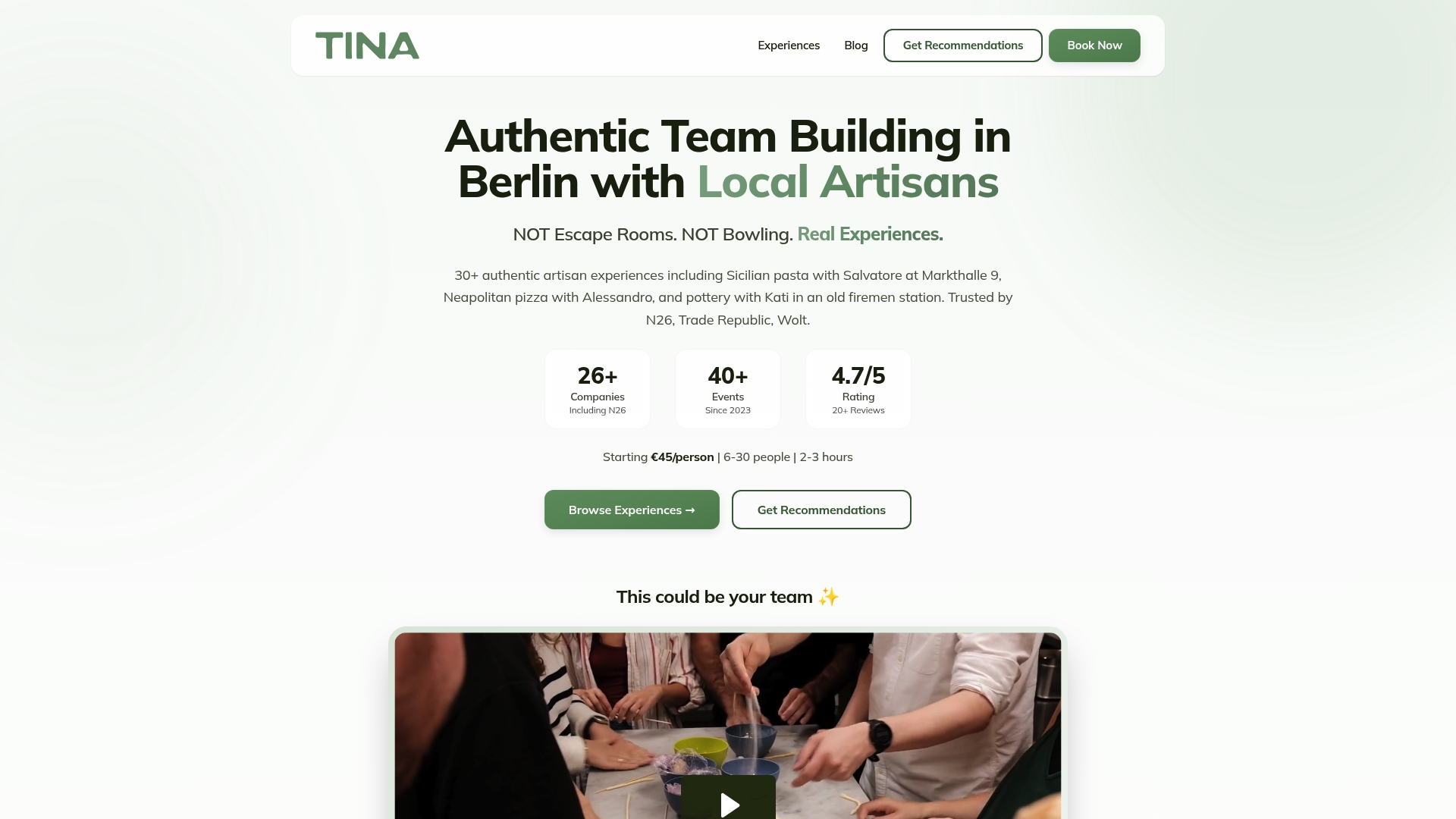
The process is simple. Browse the full catalog of hands-on artisan experiences for your team size and preferred format. Send a brief with your headcount, date, and any dietary or accessibility notes. Tinaexperiences confirms availability, handles the artisan coordination, and sends an automated invoice. No agency markup, no mystery pricing, no back-and-forth with three different vendors.
For larger groups or multi-day programs, the offsite planning page covers everything from venue sourcing to full-day logistics. Have your headcount, preferred date window, and one-line event objective ready when you reach out. That is genuinely all you need to get a quote.
Useful sources for planners
- Ideas for Team Building That Actually Work, According to Science: the clearest practitioner summary of what the research actually supports; use this to make the case to stakeholders.
- All to play for: LEGO SERIOUS PLAY and its impact on team cohesion: peer-reviewed evidence for why tactile formats produce lasting psychological safety; cite this in any internal brief.
- LEGO Serious Play at Work: Why Hands-On Building Creates Better Teams: accessible HR practitioner breakdown of the cognitive engagement argument; good for non-academic audiences.
- Top 10 MICE Destinations in Central Europe for 2026: venue and destination roundup covering Prague, Vienna, Budapest, and Berlin; useful for planners sourcing across the region.
- Corporate teambuildings move back to the city: market data on in-city format demand and typical budget ranges for Central Europe.
- Festive Meal Offerings List for Event Planners: practical catering ideas and interactive food formats for corporate groups.
- Company Christmas Party Berlin: Best Venues and Ideas: Tinaexperiences guide to Berlin-specific venue options and creative formats for the holiday season.
- Company End of Year Event Ideas That Teams Remember: specific end-of-year concepts and ways to measure event impact; useful for planners who need to report outcomes.